
ONE-TO-ONE ONLINE IB TUTORING
IB Tutor for Students With Weak Fundamentals
If your child is putting in the hours but still finding IB subjects harder than they should be, the issue is often not effort — it's a gap somewhere underneath the topic they're currently studying. A good IB tutor for students with weak fundamentals starts by finding that gap, not by piling on more practice questions.
Nivara Academy works with IB MYP and Diploma Programme students who need to strengthen core concepts before — or alongside — tackling current coursework, through personalized online IB tutoring built around each student's actual starting point.
No pressure, no obligation — just a conversation about where your child is stuck.
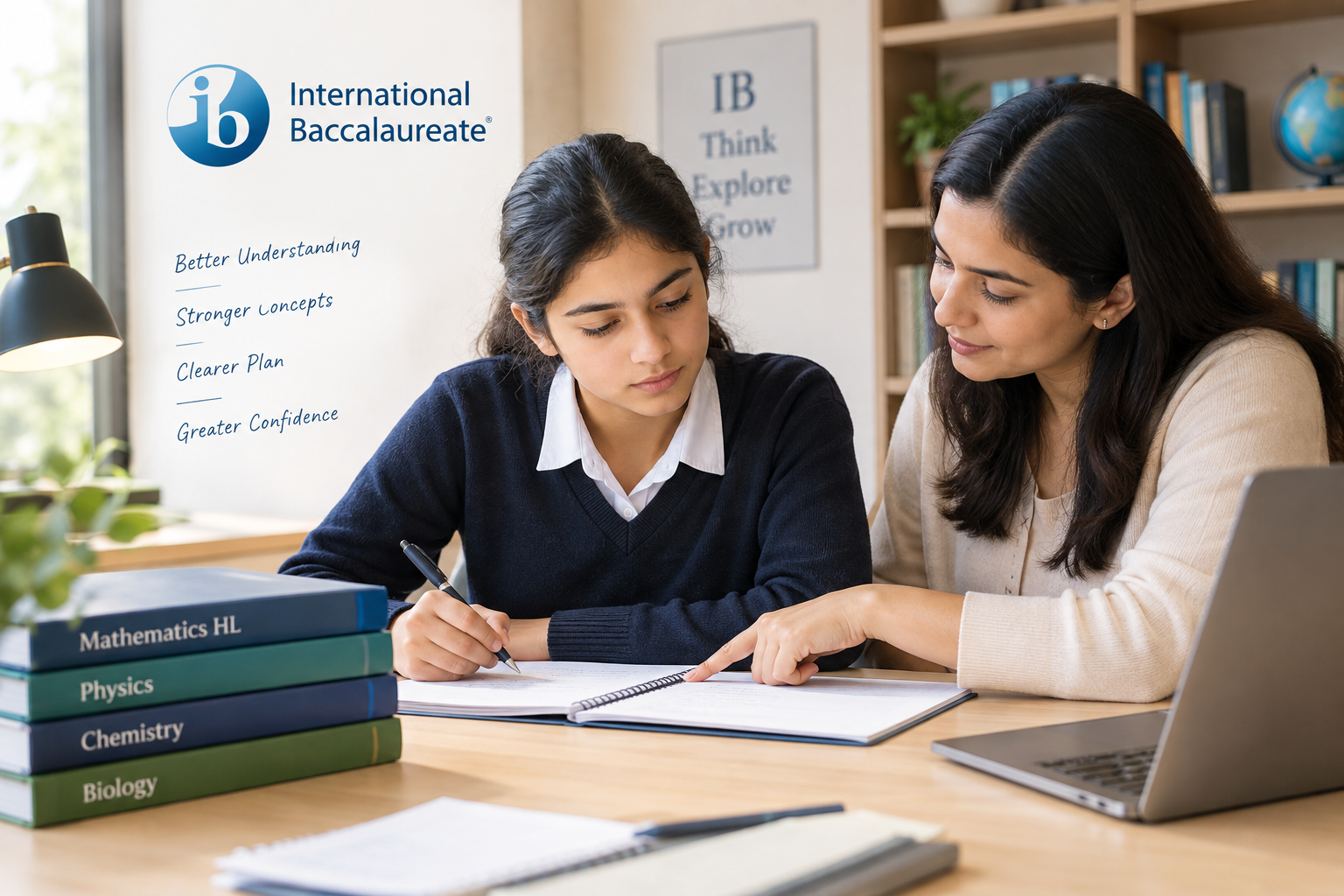
WHY THIS HAPPENS
Why weak fundamentals make the IB feel so much harder
The IB curriculum is built in layers. Almost every new unit assumes you already understand something from an earlier one — and when that earlier piece is shaky, the new topic never quite lands, no matter how many times it's explained.
- The student memorizes a formula or method without really understanding what it does, so it falls apart the moment a question looks unfamiliar.
- A concept from a previous year or unit was never fully understood, and everything built on top of it since has been slightly wobbly.
- Homework that should take 40 minutes stretches into two hours, because each step requires re-deriving something that should be automatic.
- They can follow a worked example in class but freeze when asked to apply the same idea to a new context.
- Repeated small mistakes on tests start to chip away at confidence, even when the student is clearly capable.
- HL subjects in particular feel overwhelming, not because the new content is impossible, but because the prerequisite knowledge underneath it is incomplete.
- Class moves at a pace set for the group, so there's rarely time to pause and rebuild an earlier concept properly.
- By the time exams approach, there's a mix of "new" material and "old, half-understood" material to deal with at once.
None of this reflects a student's ability. It's a common, fixable pattern — and it's exactly the kind of pattern that a subject-specific IB tutor is trained to notice and work through.
GETTING SPECIFIC
What "weak fundamentals" actually means
"Weak fundamentals" gets used as a catch-all phrase, but it can mean several different things — and the right kind of support depends on which one is actually going on.
Not understanding the current topic
The lesson itself hasn't clicked yet, but the groundwork underneath it is solid.
A gap in prerequisite knowledge
An earlier concept — from last year, or even earlier — was never fully secure, and it's affecting everything built on top of it.
Weak study habits
The understanding is closer than it looks, but revision methods aren't reinforcing it effectively.
Difficulty applying concepts
The student knows the theory but struggles to use it flexibly in unfamiliar, IB-style questions.
Forgotten earlier material
It was understood once, but without regular use, it has faded and needs a proper refresh.
Needing a different explanation
The concept just hasn't been explained in a way that matches how this particular student thinks.
This distinction matters. A student with a genuine prerequisite gap doesn't need ten more practice worksheets on the current topic — they need someone to identify exactly where the chain of understanding broke, and rebuild from there. That's the starting point for any useful IB academic support.
THE APPROACH
How one-to-one IB tutoring helps rebuild a shaky foundation
Every student's path looks a little different, but personalized IB tutoring at Nivara Academy generally follows a similar shape. Not every student moves through all of these stages in the same order, or at the same speed — the process adapts as the tutor learns more about the student.
Identify knowledge gaps
The tutor asks diagnostic questions and reviews recent work to see exactly where understanding breaks down — not just which topic, but which specific concept within it.
Revisit prerequisite concepts
Where an earlier concept is shaky, the tutor goes back to it directly, rather than working around it.
Explain the current IB topic clearly
With the groundwork in place, the current syllabus topic is taught again — this time with a foundation underneath it.
Practice guided questions
The student works through questions with support close at hand, so mistakes get caught and explained immediately rather than reinforced.
Move toward independent problem solving
Support is gradually reduced as the student becomes able to work through similar questions unassisted.
Connect foundational concepts to IB-style questions
The tutor links the rebuilt fundamentals directly to how IB command terms and assessment questions are actually structured.
Review mistakes and reinforce weak areas
Errors are treated as useful information, not something to move past quickly — they point directly at what still needs attention.
Build sustainable study habits
Over time, the goal shifts from tutor-led support to habits the student can rely on independently, well beyond the current unit.
SUBJECT-BY-SUBJECT
Weak fundamentals look different in every IB subject
A gap in understanding doesn't show up the same way in every subject. Subject-specific IB tutoring works precisely because a strong IB Maths tutor and a strong IB English tutor are looking for very different warning signs. A student rarely needs help across every subject at once — support is usually targeted at one or two areas that are causing the most difficulty.
IB Mathematics
Gaps often trace back to algebra, equations, functions, or graphing — skills that HL and SL topics assume are already automatic. An IB Maths tutor typically starts there before returning to the current unit.
IB Physics
Difficulty is frequently rooted in the mathematical foundations behind Physics — units, formula manipulation, and graph interpretation — rather than the Physics concept itself. An IB Physics tutor untangles which one is actually the problem.
IB Chemistry
Atomic structure, bonding, and mole concepts sit underneath most later topics. When these aren't secure, stoichiometry and chemical reasoning become guesswork. An IB Chemistry tutor rebuilds this layer directly.
IB Biology
Terminology and foundational processes matter as much as memorized facts. An IB Biology tutor focuses on helping students interpret data and connect concepts, not just recall definitions.
IB Economics
Basic economic concepts, diagrams, and cause-and-effect reasoning form the backbone of every evaluation question. An IB Economics tutor strengthens this reasoning before working on exam-style evaluation.
IB Business Management
Terminology, calculations, and case-study application often need separate attention. An IB Business tutor works on each piece so students can apply theory confidently to unfamiliar cases.
IB English
Comprehension and textual analysis depend on comfort with evidence and argument-building. An IB English tutor works on structuring written expression so ideas come across clearly under exam conditions.
MYP & DIPLOMA PROGRAMME
Foundational gaps affect MYP and DP students differently
Weak fundamentals aren't limited to one stage of the IB. In MYP, gaps often show up as a student falling slightly behind the pace of a unit; in the Diploma Programme, the same kind of gap can suddenly feel much bigger, because HL and SL coursework, internal assessments, and exam preparation all compound at once.
Support through Nivara Academy is tailored to where a student actually is, taking into account:
- the student's current level and year group
- the specific subject and topic involved
- whether the subject is being taken at HL or SL
- the student's current school syllabus and pace
- upcoming assessments, internal assessments, or exams
- the specific knowledge gaps identified during early sessions
This means an MYP student preparing for the transition into DP and a Year 2 Diploma student preparing for final exams receive very different kinds of support, even if both are described as having "weak fundamentals."
INSIDE A SESSION
What personalized IB tutoring support may look like
Every student is different, so the exact structure of a session depends on the subject, the gap being addressed, and how the student learns best. A typical one-to-one online IB tutoring session may involve:
- Reviewing a difficult concept from a recent class or assignment
- Asking diagnostic questions to see exactly where understanding breaks down
- Working through examples together, step by step
- Explaining the reasoning behind an answer, not just the final result
- Practicing IB-style questions that mirror real exam phrasing
- Reviewing recent mistakes to understand exactly what went wrong
- Creating targeted practice around the specific weak area
- Checking understanding before moving on to new material
- Adjusting pace based on how the student is responding
- Connecting new concepts back to earlier knowledge already covered
WHY IT MATTERS
Why it helps to address fundamentals before moving forward
It's tempting to respond to a struggling grade with more practice questions on the current topic. But when the real issue is a gap underneath that topic, more repetition on the same level tends to produce frustration rather than progress.
Working on foundational knowledge first — even if it feels like a step backward — tends to support:
- Conceptual understanding that holds up under exam pressure, not just familiar homework conditions
- Accurate foundations that later topics can be built on without needing to be re-taught
- Confidence that comes from genuinely understanding a topic, rather than guessing correctly
- Independent problem-solving, so the student isn't dependent on seeing a similar example first
- Better transfer of knowledge to unfamiliar, IB-style application questions
- More efficient revision later, because there's less relearning to squeeze in before exams
This isn't a promise of a particular grade outcome — every student's situation is different. It's simply a more sustainable way to approach subjects where the current struggle traces back to something earlier.
FOR PARENTS
If your child is working hard but still struggling, start by finding the gap
Many of the parents who reach out to us describe a similar pattern: their child is putting in real effort, but something still isn't translating into results. A few things we hear often:
- "My child studies for hours but doesn't seem to actually understand the material."
- "They understand a concept quickly, then seem to forget it within a week or two."
- "Homework is taking far longer than it should, for every subject."
- "They're hesitant to ask questions in class, even when they're confused."
- "They can follow along when someone explains it, but can't do it alone afterward."
- "Their grades have started slipping over the past term."
- "They've just moved into a more demanding IB year and everything feels heavier."
None of these point to a lack of ability — they usually point to a specific gap somewhere in the chain of understanding. A subject-specific IB tutor can help pinpoint that gap through a few diagnostic sessions, and build a plan around it that complements what's already happening at school, rather than working against it.
FOR STUDENTS
If you're reading this yourself — this is worth hearing
Having gaps in your understanding doesn't mean you're not capable of doing well in a subject. It usually just means something earlier didn't fully click, and nobody has had the time to go back to it with you properly yet.
- It's completely okay to go back and review something you "should" already know.
- Understanding the basics properly usually makes the harder IB topics easier to approach, not more complicated.
- Asking questions — even ones that feel basic — is a normal, useful part of learning, not a sign of falling behind.
- Progress often comes more from understanding why a mistake happened than from doing yet another set of similar questions.
Rebuilding a foundation takes a bit of patience, but it's one of the most reliable ways to make a subject feel manageable again.
ABOUT NIVARA ACADEMY
Personalized online IB tutoring, built around each student
Nivara Academy provides one-to-one online IB tutoring for MYP and Diploma Programme students, including both HL and SL subjects. We work with international students across different school syllabuses and time zones, with sessions scheduled around each family's routine.
Our approach centers on subject-specific support rather than generic tutoring: sessions are planned around the individual student's current gaps, pace, and upcoming assessments, with the explanation style adjusted to how that particular student learns best. Whether a student needs a short-term push before an assessment or a longer-term rebuild of core concepts across a subject, sessions are structured around that specific goal rather than a fixed curriculum.
Related: [Internal Link: IB Tutoring] · [Internal Link: IB Private Tutor] · [Internal Link: IB DP Tutoring] · [Internal Link: IB MYP Tutoring] · [Internal Link: IB Academic Support]
HOW WE APPROACH TUTORING
What effective IB subject support actually requires
Rebuilding weak fundamentals isn't just about spending more hours on a subject — it depends on a few specific things coming together:
- Subject-specific knowledge, so a tutor understands exactly how a concept is taught and assessed within that subject.
- Familiarity with the IB curriculum, including how MYP and DP topics build on each other over time.
- Personalized explanations, adjusted to the way a specific student understands ideas, rather than a single fixed method.
- Structured learning, so sessions build logically instead of jumping between unrelated topics.
- Targeted feedback on actual student work, rather than generic tips.
- Evidence-based practice, drawing on approaches that are known to support long-term understanding rather than short-term memorization.
- Understanding command terms and IB-style questions, so students learn to recognize exactly what an exam question is asking for.
For students and parents who want to understand more about how IB assessment and curriculum requirements work, the International Baccalaureate (IB) official website is a useful independent reference alongside subject-specific tutoring support.
COMMON QUESTIONS
Frequently asked questions
Find out where your child's learning gap actually is
A short demo class with an IB tutor for students with weak fundamentals is a low-pressure way to see exactly what's going on, and what a realistic plan forward could look like.