
An IB Tutor for Students New to the IB Curriculum
The first months of the IB Curriculum can feel very different from any school system a student has used before. An IB tutor for students new to the IB Curriculum helps your child understand what's actually being asked of them — subject by subject, assignment by assignment — so the adjustment period is shorter and a lot less stressful.
No obligation. A short conversation to understand where your child needs support before anything is arranged.
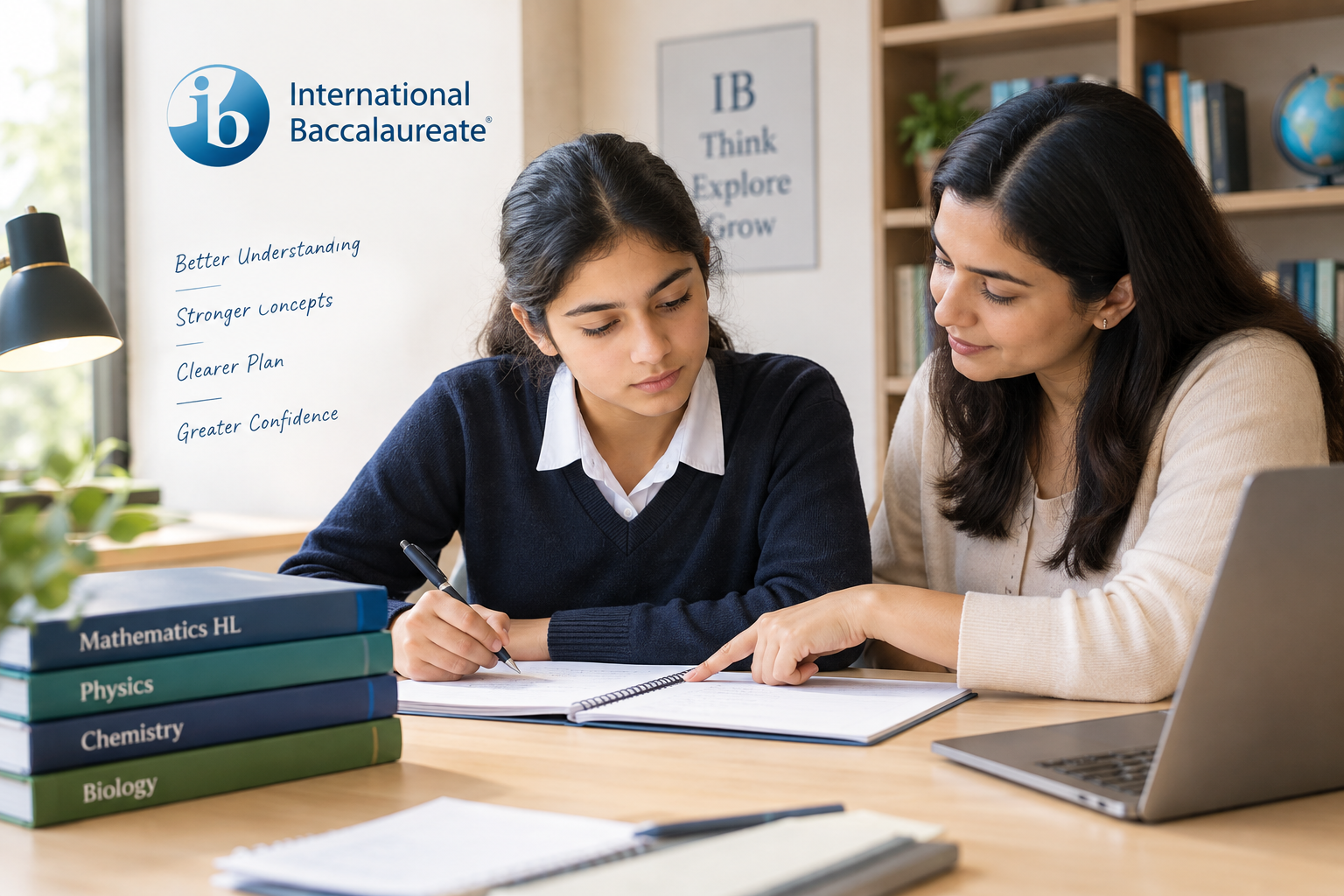
Why Students New to the IB Curriculum Often Need Extra Support
Most students joining the IB Curriculum are academically capable — that's rarely the issue. What trips students up early on is the format: several subjects assessed in different ways, longer independent assignments, and command terms like "evaluate," "discuss" or "to what extent" that assume a level of exam literacy nobody has taught them yet.
Students moving from GCSE, CBSE, A-Levels or another national curriculum are often used to being told exactly what to revise. The IB Curriculum expects more self-direction from the start — managing coursework deadlines across six subjects, keeping a reflective process for internal assessments, and balancing academic work with CAS and, at Diploma level, the Extended Essay. None of this means a student is behind. It usually just means they haven't been shown how the system works yet.
How an IB Tutor for Students New to the IB Curriculum Can Help
A tutor who understands the IB Curriculum can translate the programme's expectations into something concrete: what a Level 7 response actually contains, how an Internal Assessment is meant to be structured, or how to read a rubric before starting a task rather than after it's handed back. For a student who is new to IB, that clarity alone removes a lot of the early guesswork.
Just as importantly, one-to-one sessions give a student somewhere to ask the questions they might feel too unsure to ask in a full classroom — why a mark was lost, what "synthesis" means in an essay question, or how to plan a term that has three internal assessments due in the same fortnight.
What Makes the IB Curriculum Different?
Understanding the shape of the IB Curriculum helps explain why an adjustment period is normal, not a sign that something has gone wrong.
A more familiar school curriculum
- Heavier emphasis on final exams
- Narrower subject choice in the senior years
- Assessment criteria often less explicit
- Coursework set and paced mostly by the teacher
The IB Curriculum (MYP / DP)
- Continuous assessment alongside exams
- Six subject groups plus Theory of Knowledge and the Extended Essay at DP
- Detailed, published assessment criteria for every task
- Students expected to manage their own deadlines and reflection
How IB Tutoring Supports Students
Good IB tutoring isn't just extra subject lessons. It works on the skills that sit underneath every IB subject — the ones a new student hasn't had time to build yet.
Understanding IB Expectations
Working through assessment criteria and command terms together, so a student can look at a task and know what a strong answer needs to include before they start writing.
Building Strong Study Habits
Planning study time across several subjects at once, and building routines that hold up once internal assessments, tests and CAS commitments start overlapping.
Subject-Specific Support
Focused help with the subjects a student finds hardest, whether that's Mathematics, a Science, Language and Literature or another Diploma or MYP subject.
Improving Assignment Skills
Breaking Internal Assessments, essays and the personal project into manageable stages, with feedback on drafts before a deadline rather than after.
Preparing for IB Assessments
Practising with past paper questions and mark schemes so a student knows how marks are actually awarded, not just what topics might come up.
Developing Confidence and Independence
The long-term aim of tutoring is a student who needs less guidance over time — someone who can plan their own work and judge their own drafts.
IB Tutoring for Different Stages of the IB Curriculum
What a student needs from tutoring changes depending on where they are in the IB Curriculum. Not every student needs the same kind of support.
Middle Years Programme (MYP)
Students new to the MYP are often getting used to criterion-referenced grading for the first time, alongside interdisciplinary units and a personal project later in the programme. Tutoring at this stage tends to focus on subject foundations and getting comfortable with how MYP work is assessed, so the transition into DP is less of a jump.
Diploma Programme (DP)
Students new to the DP are managing six subjects, Theory of Knowledge, the Extended Essay and CAS at the same time. Tutoring here often centres on time management across subjects, Internal Assessment planning, and building exam technique well ahead of the final assessments.
What Can Students Expect From IB Tutoring?
Tutoring generally follows a straightforward process, so there are no surprises for a student walking in for the first time.
An initial conversation
A short discussion — often the demo session — to understand which subjects or tasks are causing difficulty and what the family is hoping to get from tutoring.
A focus for sessions
Sessions are built around the specific subjects, assignments or skills identified, rather than a generic syllabus every student follows.
Regular one-to-one sessions
Ongoing sessions at a pace that suits the student's timetable, with work between sessions kept realistic alongside school commitments.
Review and adjustment
As a student's needs change through the term — a new Internal Assessment, an upcoming exam — the focus of sessions is adjusted accordingly.
How Parents Can Tell When an IB Student Needs Extra Support
It isn't always obvious from the outside when a student is struggling to keep up with the IB Curriculum. A few common signs to watch for:
- Homework or coursework consistently takes far longer than it should
- Feedback on assignments mentions the same issue repeatedly
- A student avoids starting Internal Assessments or essays until close to the deadline
- Confusion about what a task is actually asking for, even after re-reading it
- Growing anxiety around specific subjects rather than IB as a whole
- Marks that don't reflect the effort a student is clearly putting in
None of these on their own mean a student needs tutoring — but a pattern across a few of them is usually worth a conversation.
Why Personalized IB Tutoring Can Be Helpful
Every student arrives at the IB Curriculum from a different starting point — a different previous school system, different subject strengths, and different reasons for finding the transition difficult. Personalized IB tutoring means sessions are shaped around that starting point rather than a fixed programme every student works through in the same order.
In practice, this can mean spending more time on exam technique for one student and more time on essay structure for another, even if they're studying the same subject.
Personalized tutoring can adjust for:
- Which subjects or assignment types are causing the most difficulty
- How much structure a student needs versus independence
- Upcoming deadlines for Internal Assessments, essays or exams
- A student's pace of learning in a particular subject
- Confidence levels, not just academic gaps
Talk to Us About IB Support
A short demo session is the easiest way to understand whether IB tutoring is the right fit for your child, and where sessions would be most useful.
Frequently Asked Questions About IB Tutoring
What is an IB tutor?
An IB tutor is someone who works with a student one-to-one on the specific subjects, skills and assessment style used in the International Baccalaureate programme, including the command terms and criteria used in IB exam questions and coursework.
Is IB tutoring useful for students who are new to the IB Curriculum?
Yes. Many students who are capable and hard-working still find the first months disorienting simply because the format is unfamiliar. Tutoring for new IB students focuses on explaining the structure of the programme and what's expected, so early adjustment doesn't turn into ongoing stress.
How can an IB tutor help a student adjust to the IB Curriculum?
A tutor can walk through assessment criteria in plain language, help plan time across several subjects at once, and give feedback on drafts before they're submitted — turning vague instructions into a clear sense of what a strong response looks like.
What subjects can an IB tutor help with?
Support can cover Diploma Programme subjects across the six groups — Mathematics, the Sciences, Individuals and Societies, Language and Literature, Language Acquisition and the Arts — as well as MYP subject areas, depending on where a student needs the most help.
Is IB tutoring available online?
Yes, sessions can be arranged online, which works well for students juggling a full IB timetable, since it removes travel time and makes scheduling around school more flexible.
When should a new IB student start tutoring?
There's no single right moment. Some families start early to build good habits before gaps appear; others begin once a specific subject or assignment starts causing stress. Tutoring can help at any stage of MYP or DP.
Can IB tutoring help with exam preparation?
Yes. Sessions can focus on past paper practice, command terms, mark scheme expectations and time management under exam conditions, alongside subject content itself.
Can tutoring help students understand IB assignments?
This is one of the most common reasons families reach out. Assignments such as Internal Assessments, the Extended Essay or the MYP personal project come with detailed criteria and a lot of independence — a tutor can help break the task down and check drafts against the actual criteria.
Is one-to-one IB tutoring suitable for struggling students?
It can be, but it's just as often useful for students who aren't struggling academically yet feel overwhelmed by the pace or format of IB. One-to-one sessions let a tutor focus entirely on where a particular student needs support.
How does personalized IB tutoring work?
Sessions are shaped around the individual student rather than a fixed syllabus. A tutor typically starts by understanding which subjects and skills need attention, then adjusts pace and practice work as the student's needs change through the term.
Can parents arrange an IB tutoring consultation?
Yes. Parents are welcome to book a demo session to discuss where their child is finding the IB Curriculum difficult and ask questions before committing to ongoing tutoring.
What should a student prepare before their first IB tutoring session?
It helps to have recent coursework, assignment instructions or teacher feedback on hand, along with a general sense of which subjects or tasks feel most confusing — though this isn't essential to get started.
Get Started With IB Tutoring
If your child is finding the move into the IB Curriculum harder than expected, a short conversation is usually the clearest way to work out what kind of support would actually help. You can learn more about the programme itself on the official International Baccalaureate website, or reach out to us directly to discuss your child's situation.