
IB Physics: Internal Resistance Explained
A clear conceptual guide covering EMF, terminal voltage, internal resistance graphs, and IB-style exam questions for students studying the IB Diploma Physics Programme.
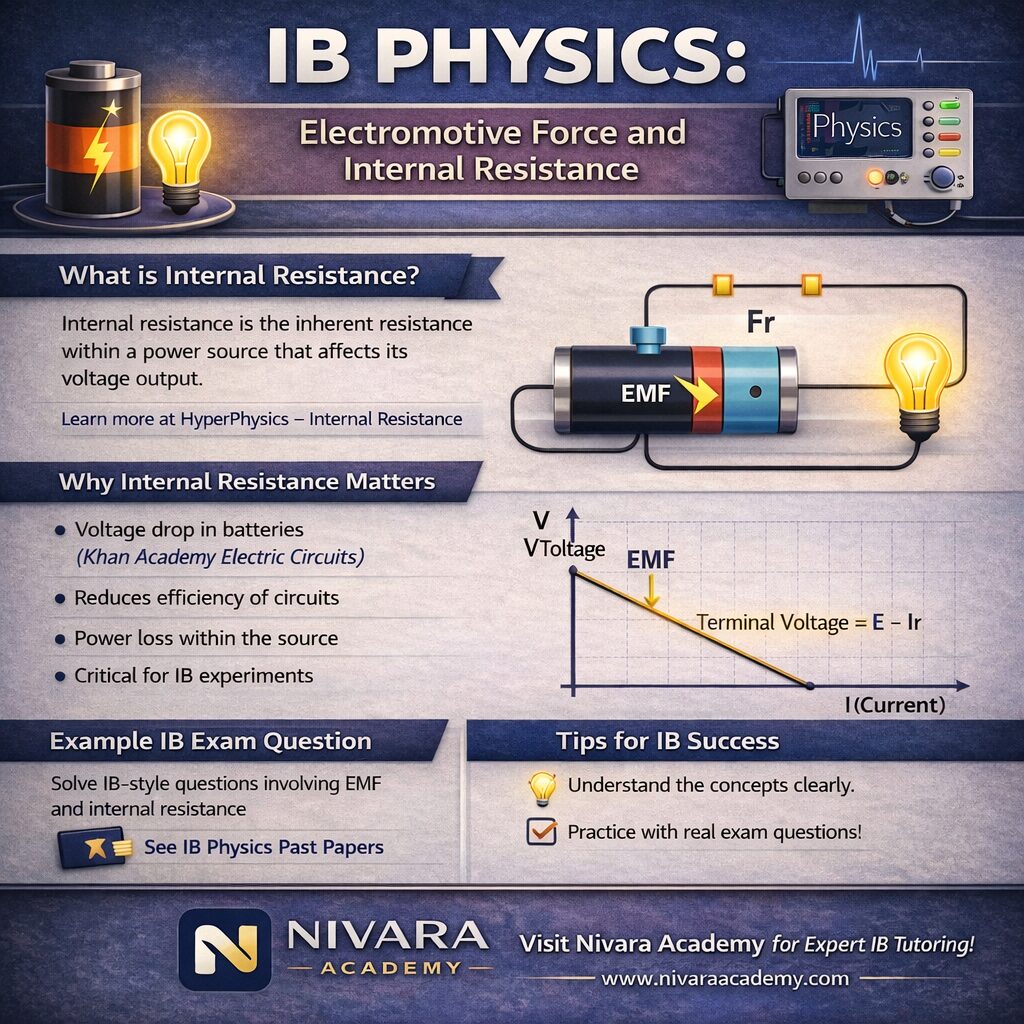
What is Internal Resistance?
In real electrical circuits, batteries and power supplies are not ideal. Every source of electromotive force contains a small resistance within it called internal resistance.
When current flows through a battery, some electrical energy is converted into heat inside the battery itself. Because of this energy loss, the voltage available to the external circuit becomes smaller than the emf of the source.
This effect becomes especially noticeable when the current drawn from the battery is large.
IB Physics Internal Resistance: EMF vs Terminal Voltage
Electromotive Force (EMF) represents the total energy supplied by a source per unit charge.
Terminal Voltage is the potential difference across the external circuit when current flows.
- V = terminal voltage
- ε = electromotive force
- I = current
- r = internal resistance
Internal Resistance Model of a Battery
A real battery can be modeled as an ideal voltage source connected in series with a resistor representing internal resistance.
IB Exam Example
A battery has an emf of 12 V and internal resistance 2 Ω. The current in the circuit is 3 A.
Find the terminal voltage.
Solution:
Using the formula:
V = 12 − (3 × 2)
V = 6 V
Although the battery has 12 V emf, the circuit receives only 6 V due to internal resistance.
Interactive Internal Resistance Calculator
Enter values to calculate terminal voltage.
Why Internal Resistance Matters
- Explains voltage drop in batteries
- Important in circuit efficiency
- Determines power loss inside sources
- Essential for interpreting IB circuit experiments
Common Mistakes IB Students Make
- Confusing emf with terminal voltage
- Ignoring internal resistance in calculations
- Misinterpreting the slope of V–I graphs
- Assuming batteries always deliver full emf
Author & Academic Credibility

This guide is written by an experienced physics educator with advanced problem-solving expertise in electromagnetism and circuit analysis. The explanations are designed to help IB students develop conceptual clarity and exam-level problem-solving ability.
Need Help with IB Physics?
Understanding topics like internal resistance, EMF, and electric circuits can be challenging in the IB Diploma Programme. Structured guidance and exam-focused practice can make a major difference.
- ✔ Concept-focused IB Physics lessons
- ✔ Step-by-step problem solving
- ✔ Past paper exam strategies
- ✔ Support for HL and SL students