
IB Physics IA Topics & Research Questions
A practical, mentor-written guide to choosing, narrowing and defending an IB Physics Internal Assessment topic — with 30+ example research questions and a step-by-step framework for building your own.
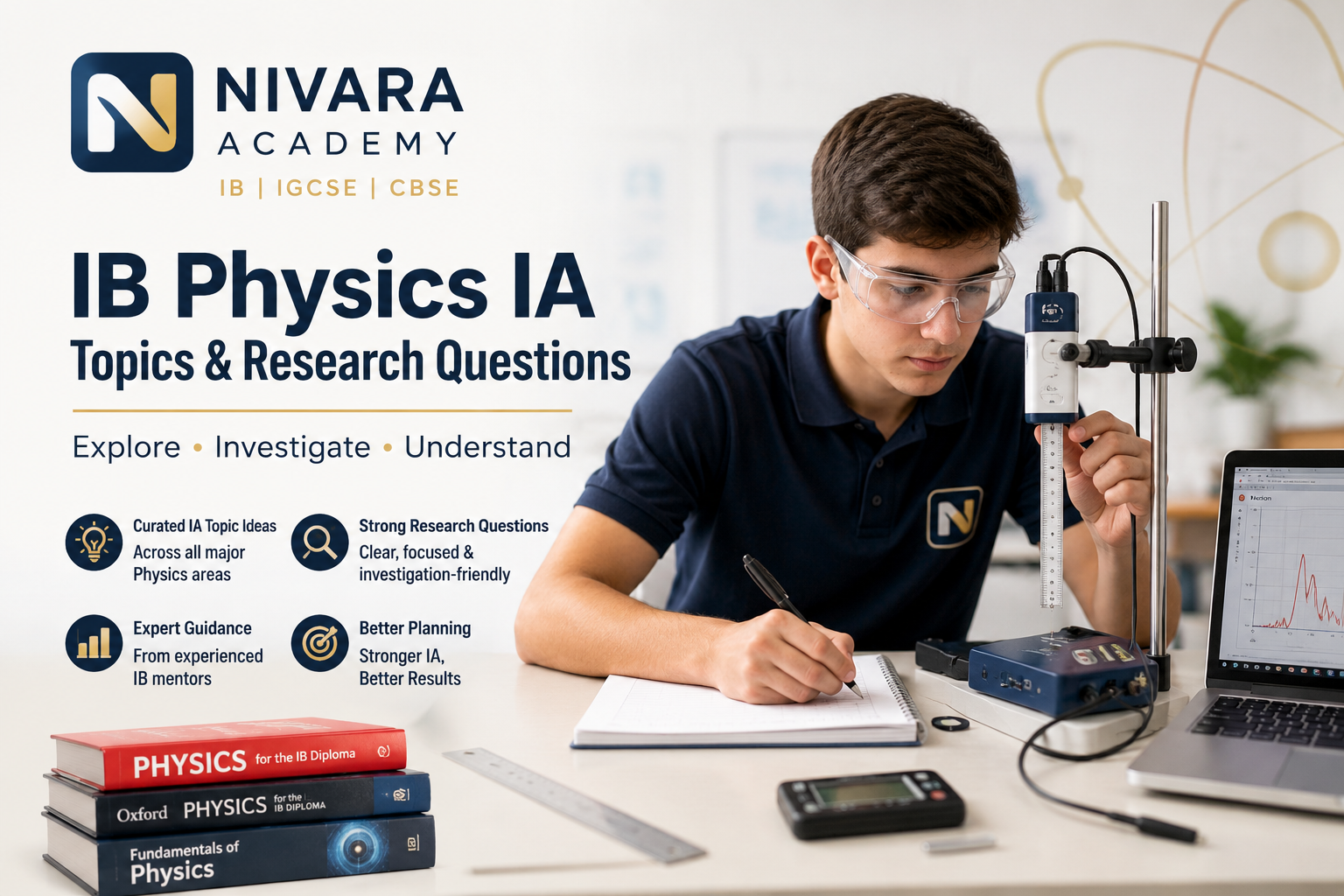
Every IB Physics student eventually hits the same wall. You know the Internal Assessment is coming, and you have a rough area in mind — projectile motion, pendulums, friction, electricity, waves, thermal physics, circular motion — but a rough area is not a research question, and a research question is not the same thing as an investigation you can actually run in your school lab with the equipment you have.
This is where most of the difficulty in IB Physics IA topics and research questions actually lives. It's rarely a lack of ideas. It's the gap between an interesting idea and a focused, measurable, testable one. A good Physics IA topic has to survive contact with reality: your equipment, your timetable, your own understanding of the physics, and the six or seven weeks you realistically have to collect and analyse data.
I've worked with IB Physics students through this exact decision for several years, mostly the same conversation on repeat: "I like the idea, but I don't know how to turn it into something I can measure." This page is written to answer that conversation directly — what makes a topic workable, how to build a research question around it, and a substantial list of starting points organised by area of the syllabus.
What Makes a Good IB Physics IA Topic?
Examiners and supervisors are not looking for an unusual or dramatic idea. They're looking at whether the investigation was designed and carried out well. A strong topic simply makes that easier to achieve. In practice, the topics that work well tend to share the same handful of features.
- Clear physics connection. You can name the concept or relationship being tested in one sentence, without hedging.
- Genuinely measurable variables. The independent and dependent variables can be recorded with instruments your school actually has.
- Appropriate scope. Narrow enough to investigate properly in the time available, not a whole branch of physics.
- Available equipment. Motion sensors, data loggers, meter rulers, stopwatches, multimeters — not equipment you'd need to source specially.
- Repeatable measurements. You can take multiple trials at each value of the independent variable without the setup drifting.
- Manageable data collection. Enough data points to support a trend line and an uncertainty discussion, without an unrealistic number of trials.
- Room for meaningful analysis. The data should lend itself to a graph, a gradient, a comparison with theory — not just a table of numbers.
- Scope for evaluation. There should be real, identifiable sources of uncertainty and limitation to discuss honestly.
- A difficulty level that matches your understanding. You should be able to explain the underlying physics without leaning on a source you don't fully follow.
- Genuine interest. You will spend weeks on this. A topic you're mildly curious about is far easier to sustain than one chosen purely because it "sounds impressive."
Quick checklist
- I can state the physics relationship being tested in one sentence.
- I know exactly which two variables I'm measuring, and how.
- My school has the equipment, or something close enough.
- I can realistically collect this data within my available lab time.
- I understand the underlying physics without outside help.
Not sure if your topic idea is workable?
Speak with Nivara Academy about personalised IB Physics academic guidance — we help you stress-test an idea before you commit weeks to it.
Get IB Physics GuidanceHow to Write an IB Physics IA Research Question
Once you have a topic area, the next job is turning it into a proper Physics Internal Assessment research question. Most workable questions follow a similar shape:
"How does independent variable affect dependent variable under controlled conditions?"
In simple terms:
- Independent variable — the one thing you deliberately change between trials.
- Dependent variable — the one thing you measure as a result.
- Controlled variables — everything else you hold constant, so the result you see is actually caused by the independent variable and not something else changing at the same time.
The framework is simple, but the discipline is in the detail: naming a range, a unit, and the conditions you're holding fixed. Here's how the same idea tightens up across three drafts.
30+ IB Physics IA Topics & Research Questions
Below is a working list of IB Physics IA topic ideas, organised by syllabus area, each with an example research question and the core variables involved. Treat these as starting points, not finished questions — you'll still need to narrow the range, decide on your equipment, and make the question your own. None of these is a "safe" route to a particular grade; the mark depends entirely on how well the investigation is designed, executed, analysed and evaluated.
Mechanics
| Topic | Example Research Question | IV / DV | Why it can work |
|---|---|---|---|
| Projectile motion | How does launch angle affect the horizontal range of a projectile launched at constant speed? | launch angle range | Motion sensors or video tracking make this measurable; theory gives a clear comparison point. |
| Friction | How does surface roughness affect the coefficient of kinetic friction for a block on an incline? | surface type friction coefficient | Simple force-meter setup; good scope for a systematic uncertainty discussion. |
| Pendulum motion | How does pendulum length affect its period of oscillation? | string length period | Classic, but still strong when the range and controls are specific and the analysis goes beyond a single graph. |
| Springs | How does the mass on a vertical spring affect its period of oscillation? | mass period | Ties directly to SHM theory; easy to extend into an energy-based analysis. |
| Collisions | How does the mass ratio of two trolleys affect the percentage kinetic energy lost in a collision? | mass ratio %KE lost | Good link between momentum and energy concepts; light gates improve precision. |
| Rotational motion | How does the distance of a mass from the pivot affect the angular acceleration of a rotating disc? | radius angular acceleration | Connects to moment of inertia; requires care with a stable rig. |
| Circular motion | How does the radius of a circular path affect the tension needed to maintain constant speed? | radius tension | Direct test of centripetal force theory with a simple whirling-bung setup. |
| Air resistance | How does the surface area of a falling paper cone affect its terminal velocity? | surface area terminal velocity | Low-cost, low-risk, and video tracking gives usable data with basic equipment. |
Scroll horizontally on smaller screens to see the full table.
Thermal Physics
| Topic | Example Research Question | IV / DV | Why it can work |
|---|---|---|---|
| Cooling | How does the initial water temperature affect its rate of cooling in a fixed container? | initial temperature cooling rate | Newton's law of cooling gives a clean theoretical model to test against. |
| Insulation | How does insulation material thickness affect the rate of heat loss from a beaker of hot water? | thickness heat loss rate | Easy to control conditions; strong real-world relevance for evaluation. |
| Thermal conductivity | How does the thickness of a metal rod affect the rate of heat conduction along it? | rod thickness conduction rate | Links directly to a named equation; needs careful temperature-probe placement. |
| Heating | How does applied voltage affect the temperature rise of water in an immersion heater setup? | voltage temperature rise | Connects electrical and thermal energy; good for an energy-efficiency discussion. |
| Surface area & heat transfer | How does the exposed surface area of a hot liquid affect its cooling rate? | surface area cooling rate | Isolates one cooling variable cleanly if container shape is controlled. |
Waves
| Topic | Example Research Question | IV / DV | Why it can work |
|---|---|---|---|
| Resonance | How does tube length affect the resonant frequencies of an air column? | tube length resonant frequency | Direct test of standing-wave theory with a simple resonance tube and tuning forks. |
| Standing waves | How does string tension affect the frequency of the fundamental standing wave on a stretched string? | tension fundamental frequency | Clear theoretical relationship; a signal generator improves measurement precision. |
| Sound | How does the distance from a sound source affect the measured sound intensity? | distance intensity | Tests an inverse-square relationship using a sound-level meter or logger. |
| String length/tension | How does the vibrating length of a guitar string affect its fundamental frequency? | string length frequency | Accessible equipment; strong link to a well-known wave equation. |
| Frequency | How does driving frequency affect the amplitude of a forced oscillator near resonance? | driving frequency amplitude | More advanced, but gives rich data for analysing damping and resonance curves. |
Electricity & Circuits
| Topic | Example Research Question | IV / DV | Why it can work |
|---|---|---|---|
| Resistance | How does the cross-sectional area of a wire affect its resistance? | cross-sectional area resistance | Direct link to resistivity theory; multimeter-only equipment needed. |
| Wire length | How does wire length affect resistance at constant temperature? | wire length resistance | Classic but effective when the analysis goes beyond a single straight-line fit. |
| Temperature & resistance | How does temperature affect the resistance of a thermistor? | temperature resistance | Good non-linear relationship to model and justify. |
| Circuit components | How does the number of identical resistors in parallel affect total circuit resistance? | number of resistors total resistance | Reinforces circuit theory with a very controllable setup. |
| Internal resistance | How does current drawn affect terminal voltage for a cell of known EMF? | current terminal voltage | Ties directly to a standard IB circuit derivation with clear graphical analysis. |
Fields
| Topic | Example Research Question | IV / DV | Why it can work |
|---|---|---|---|
| Magnetic fields | How does distance from a bar magnet affect measured magnetic field strength? | distance field strength | Works well with a Hall-effect probe or a smartphone magnetometer app. |
| Electromagnets | How does the number of coil turns affect the strength of an electromagnet? | number of turns field strength / lifting force | Simple to build; strong link to a named formula. |
| Induction | How does the speed of a magnet falling through a coil affect the peak induced EMF? | fall speed peak EMF | Good qualitative and quantitative link to Faraday's law. |
| Gravitational relationships | How does pendulum length affect the calculated value of gravitational acceleration? | pendulum length calculated g | Reframes a familiar setup around a measurement-accuracy investigation. |
Modern Physics (school-lab friendly)
| Topic | Example Research Question | IV / DV | Why it can work |
|---|---|---|---|
| LED threshold voltage | How does LED colour affect the threshold voltage needed to produce visible light? | LED colour / wavelength threshold voltage | Offers a safe, low-cost route to estimating Planck's constant. |
| Capacitor discharge | How does resistance affect the time constant of a discharging capacitor? | resistance time constant | Clean exponential relationship; data logger makes analysis straightforward. |
| Radioactive decay analogy | How does the number of dice thrown affect the modelled "decay constant" in a dice-decay simulation? | number of dice decay constant | A safe way to explore half-life and exponential decay without radioactive sources. |
Easy vs Advanced IB Physics IA Topics
"Easy" does not mean low quality. A simple, well-controlled pendulum investigation with careful uncertainty analysis will usually outperform an ambitious modern-physics idea that the student can't fully explain or execute. Choose based on your equipment, your grasp of the underlying physics, and the time you actually have — not on how impressive the topic sounds.
Beginner-friendly
Simple equipment, straightforward measurements, well-understood theory. Pendulums, springs, resistance of wires, cooling curves.
Intermediate
Requires a stronger experimental design and more careful data analysis. Resonance, thermal conductivity, collisions, internal resistance.
More advanced
May involve more sophisticated equipment, modelling, or non-linear analysis. Forced oscillation near resonance, LED threshold voltage, rotational dynamics.
How to Turn an Everyday Idea into an IB Physics IA Topic
Some of the strongest IA topics start as ordinary observations, not textbook chapters. The skill is in walking the observation through to a testable question.
For example: "Why does a phone battery get warm?" leads to internal resistance and power dissipation, which leads to a measurable investigation into how charging current affects battery surface temperature.
A few more everyday observations that can be developed the same way:
- Why does a ball bounce differently on different surfaces? → coefficient of restitution and surface material.
- Why does a bicycle slow down when you stop pedalling? → rolling resistance and air resistance as a function of speed.
- Why does the sound change with the length of a tube you blow across? → standing waves and resonant frequency.
- Why does water cool at different rates depending on the container? → surface area, material and heat loss.
- Why do different materials feel warmer or colder to the touch? → thermal conductivity.
- Why does a stretched string produce different sounds when you press it in different places? → string length and fundamental frequency.
Common Mistakes When Choosing IB Physics IA Topics
Most weak IAs don't fail because of the topic itself — they fail because of decisions made in the first week. The most common ones I see:
- Choosing a topic that's far too broad to investigate in the time available.
- Copying a topic or question from the internet without fully understanding it.
- Picking something purely because it "sounds impressive" rather than because it's workable.
- Having no clearly defined independent variable.
- Choosing a quantity that can't be measured reliably with available instruments.
- Planning around equipment the school doesn't actually have.
- Collecting too little data to support a real trend or uncertainty analysis.
- Ignoring uncertainty until the write-up, instead of planning for it from the start.
- Writing a research question that's needlessly complicated or multi-part.
- Choosing an investigation that sits outside the student's own understanding of the physics.
- Leaving topic selection until the last minute, which compresses every stage that follows.
How to Improve a Weak Physics IA Research Question
Here's the same tightening process applied across a few different areas — broad topic, first-draft question, the problem with it, and an improved version.
How Nivara Academy Supports IB Physics IA Students
Nivara Academy provides personalised academic mentoring for IB, IGCSE and CBSE students, with a particular focus on concept-driven learning rather than generic tutoring. For Physics IA support, that looks like:
- Making sense of the IA requirements and what the assessment is actually looking for.
- Brainstorming suitable topic directions based on the student's genuine interests and available equipment.
- Narrowing broad ideas into focused, workable research questions.
- Planning independent, dependent and controlled variables before data collection begins.
- Guidance on experimental design and setup.
- Support interpreting collected data and understanding what it shows.
- Clarifying the underlying physics concepts the student needs to understand.
- Feedback on the structure and reasoning of the write-up.
- Helping students identify weaknesses in their own approach before submission.
- One-to-one mentoring paced around the individual student, not a fixed curriculum.
IB Physics IA Topic Selection Checklist
Before committing to a topic, run it through this list:
- Is the physics concept clear?
- Can I measure the variables involved?
- Do I have suitable equipment available?
- Can I repeat the experiment reliably?
- Can I collect enough useful data?
- Can I control the important variables?
- Can I discuss uncertainty meaningfully?
- Is the scope manageable in the time I have?
- Do I genuinely understand the underlying physics?
- Can I explain, in my own words, why this investigation matters?
Frequently Asked Questions
What is a good IB Physics IA topic?
A good topic has a clear physics connection, measurable variables, equipment your school actually has, and a scope you can realistically manage in the time available. It doesn't need to be unusual — it needs to be well executed.
How do I choose an IB Physics IA research question?
Start from a broad topic area, identify a possible independent and dependent variable, then tighten the question using the framework "How does [independent variable] affect [dependent variable] under [controlled conditions]?" with a defined range and units.
How specific should an IB Physics IA research question be?
Specific enough that another student reading it would know exactly what you changed, what you measured, and what you held constant — including a numerical range for the independent variable where possible.
Can I use a common Physics IA topic, like pendulums or resistance of a wire?
Yes. Commonly used topics are acceptable and can produce strong investigations. What matters is the quality of the methodology, data analysis and evaluation — not how original the topic sounds.
Are easy Physics IA topics acceptable?
Yes. A simple, well-controlled investigation with a thoughtful evaluation is generally a stronger submission than an overly ambitious one the student can't fully execute or explain.
How many variables should my investigation have?
Typically one clear independent variable and one dependent variable, with several controlled variables identified and, where possible, kept constant or monitored.
Can I change my Physics IA topic later if it isn't working?
This depends on your school's internal timeline and your supervisor's guidance, so check with them directly. In general, the earlier a problem is identified, the easier it is to adjust the topic or question without losing time.
What makes an IA research question too broad?
Usually a missing or vague independent variable, no defined range or conditions, or a question that could be answered in several unrelated ways. If you can't picture the exact experiment from the question alone, it's too broad.
Can Nivara Academy help me choose my Physics IA topic?
Yes. Nivara Academy offers one-to-one mentoring to help students brainstorm topic directions, narrow research questions, and plan their investigation with proper academic guidance.
Does Nivara Academy write the IA for students?
No. Mentoring is designed to help students understand the requirements, make their own informed decisions, and develop their own investigation and analysis. The work submitted is always the student's own.