
Online One-to-One IB Maths Tutoring
IB Maths Word Problems Made Easier
Know the formulas but still lose marks when a question arrives wrapped in a story? Nivara Academy helps IB students read, interpret and solve application questions with a clear, repeatable method, so the mathematics you already know actually gets used.
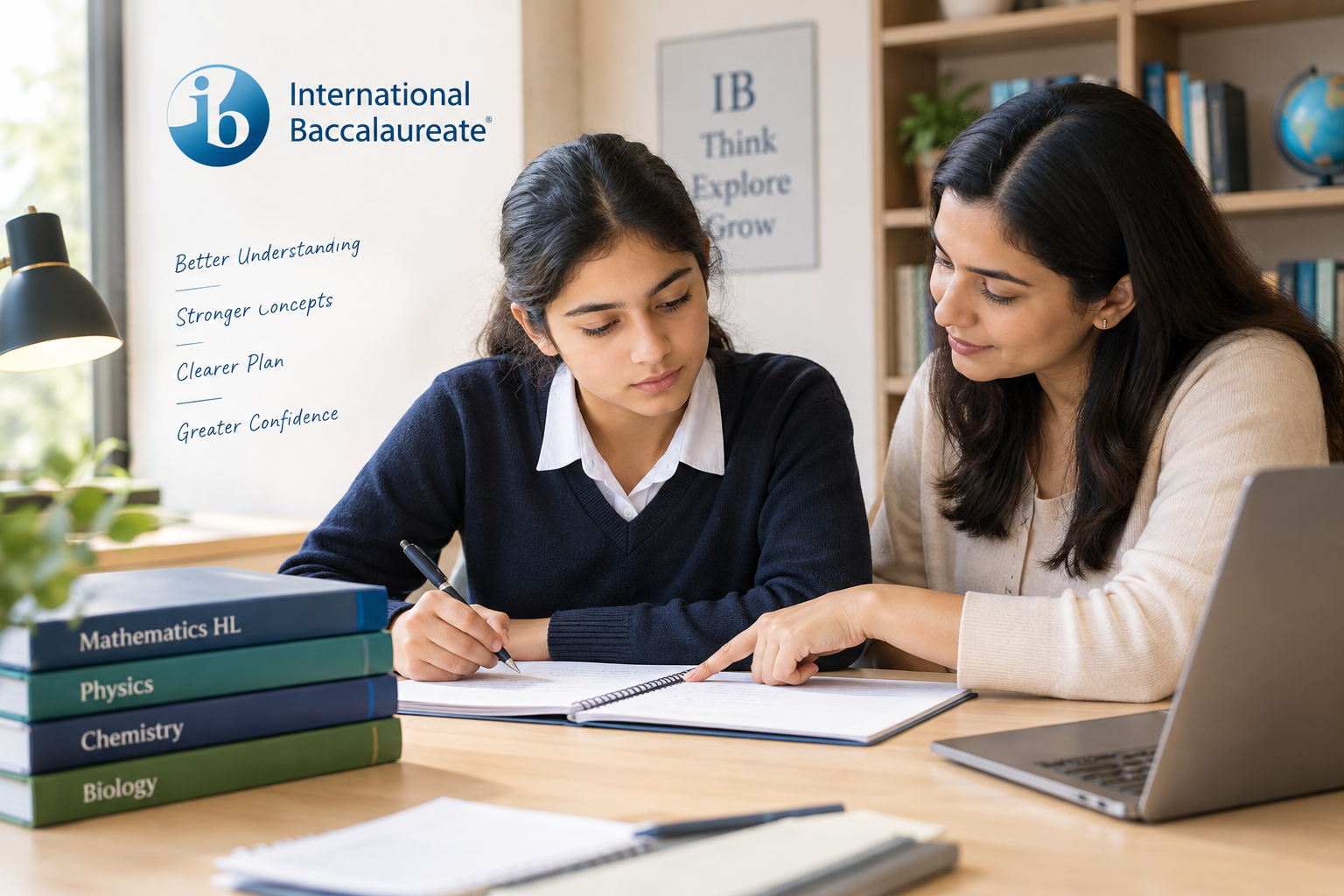
Most students who struggle with IB Maths word problems are not weak at maths. They can differentiate, solve a quadratic or use a formula when the question is written in symbols. The trouble starts when the same idea is hidden inside a paragraph about a taxi company, a cooling cup of tea or a population of bacteria.
IB Maths Word Problems Made Easier is about closing that gap. A word problem asks you to interpret information, identify the mathematical task, choose an approach and communicate your reasoning. Each of those is a skill that can be practised.
Nivara Academy provides online one-to-one IB Maths tutoring for students who want structured help with problem solving. This page gives you a method you can start using today, two worked examples, and an honest look at how tutoring can help. For syllabus details, always refer to the official International Baccalaureate website.
Why IB Maths Word Problems Feel Difficult
Knowing mathematics and applying mathematics are different skills. Practising twenty identical quadratics trains you to recognise a pattern. An IB application question removes the pattern and asks you to build the setup yourself.
The reading load
Long questions contain useful numbers, distracting numbers and context that matters only for interpreting the answer.
The hidden task
The question rarely says "use the discriminant". You must decide what is being asked and which concept fits.
The unfamiliar context
The setting may be new, but the mathematics underneath is usually something you already know.
The marks for reasoning
Method and communication earn marks. A correct answer with no working can lose credit.
IB Maths Word Problems Made Easier: A Simple 7-Step Method
This framework works across IB Maths problem solving, from short application questions to multi-part exam questions.
- Read the question twice. First for the story, second with a pen, underlining numbers, units and conditions.
- Identify what is known. Write each given value with its unit and meaning.
- Identify what is being asked. Circle the final request and note the command term and the required form (exact, 3 s.f., in dollars).
- Translate the wording into mathematics. Define variables, then write an equation, expression or diagram.
- Choose the method. Match the structure of the situation to a model or formula, rather than the one that looks familiar.
- Work through it clearly. Show setup, substitution and steps. Keep full calculator values until the end.
- Check and interpret. Does the answer make sense in context, with sensible units and accuracy?
Worked example 1: comparing two prices
A bike-hire shop charges a fixed fee of $15 plus $4 per hour. A rival shop charges $6 per hour with no fixed fee. After how many hours do both shops cost the same?
Known: fixed fee $15, hourly rate $4 (shop A); hourly rate $6, no fee (shop B).
Asked: the number of hours at which the two costs are equal.
Setup: let h be hours.
Reasoning: "the same" tells us to set the two cost models equal. Both are linear because the rate per hour is constant.
Answer: 7.5 hours.
Check: Shop A: 15 + 4(7.5) = 45. Shop B: 6(7.5) = 45. Both give $45. Shop B is cheaper for fewer hours, which fits its lack of a fixed fee.
Worked example 2: growth over time
A student invests $5,000 at 3.2% per year, compounded quarterly. How long until the investment first exceeds $6,000?
Known: principal 5000, rate 3.2%, four compounding periods per year, target 6000.
Asked: the time t in years when the balance reaches $6,000.
Setup: the compound interest model with t in years.
Reasoning: the unknown is in the exponent, so use logarithms (or the equation solver on your GDC). Do not round 22.88 before dividing by 4.
Answer: about 5.72 years. Interest is added quarterly, so the balance first passes $6,000 during the 23rd quarter.
Check: 5000 × 1.00823 ≈ 6,005 (just above 6,000), while 22 quarters gives about 5,957 (just below).
How to Translate Words Into Mathematics
Translating words into equations becomes easier once you recognise common phrasing. These are small patterns, not rules to memorise blindly. Always check the context.
| Wording | Likely mathematics |
|---|---|
| "is increased by 8%" | Multiply by 1.08 |
| "decreases by 12% each year" | Multiply by 0.88 each year (geometric) |
| "three more than twice a number" | 2x + 3 |
| "rate of change" | A derivative, or a gradient |
| "fixed charge plus per unit" | y = c + mx (linear) |
| "at least" / "no more than" | ≥ / ≤ in an inequality |
Define your variables in words first, such as "let t = time in hours", before writing any equation.
How to Decide Which Formula or Method to Use
Strong students read for structure. Ask what kind of change the situation describes:
- Constant amount added each step: linear or arithmetic.
- Constant percentage change: exponential or geometric.
- Maximum, minimum or fastest rate: differentiation.
- Total accumulated or area: integration.
- Sides and angles of a real shape: trigonometry, sine rule or cosine rule.
- Repeated trials with fixed probability: binomial distribution.
If two methods seem possible, check which one uses the information the question actually gives you. Choosing the correct formula comes from recognising the situation, not from guessing.
How to Break a Long IB Maths Question Into Smaller Steps
Multi-step questions feel large because you try to hold everything in your head. Instead:
- Sketch a quick diagram or table of the situation.
- Write a one-line goal for each part, such as "find the speed", then "use it to find the time".
- Look at how parts connect: earlier answers are often needed later, so keep exact values.
- Do the easiest correct step first to build momentum.
- If stuck, write what you do know. Method marks often start there.
Common Mistakes Students Make With IB Maths Word Problems
Starting too early
Calculating before understanding the question leads to neat but irrelevant working.
Using every number
Some values are distractors, or are needed only in a later part.
Formula by familiarity
Picking a formula because you recognise it, instead of because it fits.
Ignoring units
Mixing minutes with hours or metres with centimetres changes the answer.
Rounding too early
Rounding mid-way can push the final answer outside the accepted accuracy.
Bare answers
Missing working, missing command terms and unexplained answers all cost marks.
Also ask: is this realistic? A negative time, a probability above 1 or a person 14 metres tall is a signal to recheck.
IB Maths Word Problems in Maths AA and Maths AI
Application and modelling questions can appear in every IB Maths course, but they tend to feel different. The exact assessment structure is set by the IB, so always check the current subject guide on the official site.
- Maths AA SL and HL: contexts often lean on algebraic, functional and calculus reasoning. HL generally expects deeper reasoning and more abstract extension.
- Maths AI SL and HL: mathematical modelling, data, statistics and technology use are central, so interpreting a context and using the calculator effectively matter a lot.
In both courses the core skill is the same: translate the situation, choose a method, show working and interpret the result.
How One-to-One IB Maths Tutoring Can Help
Group classes move at the pace of the room. One-to-one tutoring moves at yours. A tutor can:
- Diagnose exactly where you get stuck: reading, setup, method or communication.
- Give you unfamiliar questions to practise on, not just repeats.
- Improve how you interpret mathematical questions and command terms.
- Build structured problem-solving habits you can repeat under exam conditions.
- Review mistakes with you to find the cause.
- Develop exam technique and working presentation.
- Support both HL and SL material, with past-paper-style practice appropriate to your level.
Tutoring supports your effort. It cannot promise a particular grade, but it can make your preparation more focused. Nivara Academy sessions are online, so you can learn from wherever you are.
Who Can Benefit From IB Maths Word Problems Made Easier?
- Students who know the formulas but struggle to apply them.
- Students who lose marks on application questions.
- Students preparing for mock or final exams.
- Students who find multi-step questions overwhelming.
- Students moving into IB Maths from another curriculum.
- Students who want more confidence with unfamiliar questions.
- Parents looking for structured one-to-one support for their child.
IB Maths Word Problems Made Easier: Frequently Asked Questions
What are IB Maths word problems?
They are questions where a real-world or abstract situation is described in words and you must create the mathematics yourself, then solve and interpret it.
Why do students struggle with IB Maths word problems?
Usually because of interpretation, not calculation. Students must decide what information matters, what is being asked and which method fits.
How can I make IB Maths word problems easier?
Use a repeatable method: read carefully, list knowns, identify the question, define variables, choose a method, show working and check the answer.
How do I know which formula to use?
Look at the structure of the situation, such as constant addition, constant percentage change or rate of change, rather than choosing a formula that simply looks familiar.
How can I improve my IB Maths problem-solving skills?
Practise unfamiliar questions regularly, review every mistake to find its cause, and write out your setup and reasoning in full.
Are word problems different in Maths AA and Maths AI?
They can feel different, as Maths AI often emphasises modelling, data and technology, while Maths AA often emphasises algebraic and calculus reasoning. Check the IB subject guide for the official details.
Can one-to-one tutoring help with application questions?
Yes. A tutor can identify where you get stuck, give targeted practice and help you build a structured approach to interpreting and solving application questions.
Can I book an IB Maths demo class?
Yes. You can book an IB Maths demo class through the Nivara Academy demo page and discuss your needs with a tutor.
Make IB Maths Word Problems Easier With Nivara Academy
If you want IB Maths Word Problems Made Easier with personal guidance, book a demo class and tell us where you get stuck. We will help you plan the next step.
Nivara Academy is an independent tutoring provider and is not affiliated with or endorsed by the International Baccalaureate.