
Nivara Academy · IB Mathematics Support
IB Maths Tutor for Weak Students
If your child is finding IB Maths difficult, it usually isn't about effort — it's about clarity. A weak start in Mathematics can come from a missed concept, a gap in the basics, or lessons that moved on before the idea fully settled. An experienced IB Maths tutor for weak students works patiently through those gaps, rebuilds the foundation, and helps the student approach problems with a clearer, calmer method.
Nivara Academy offers personalised IB Maths tutoring for SL and HL students following the AA or AI syllabus, with a focus on understanding rather than memorising.
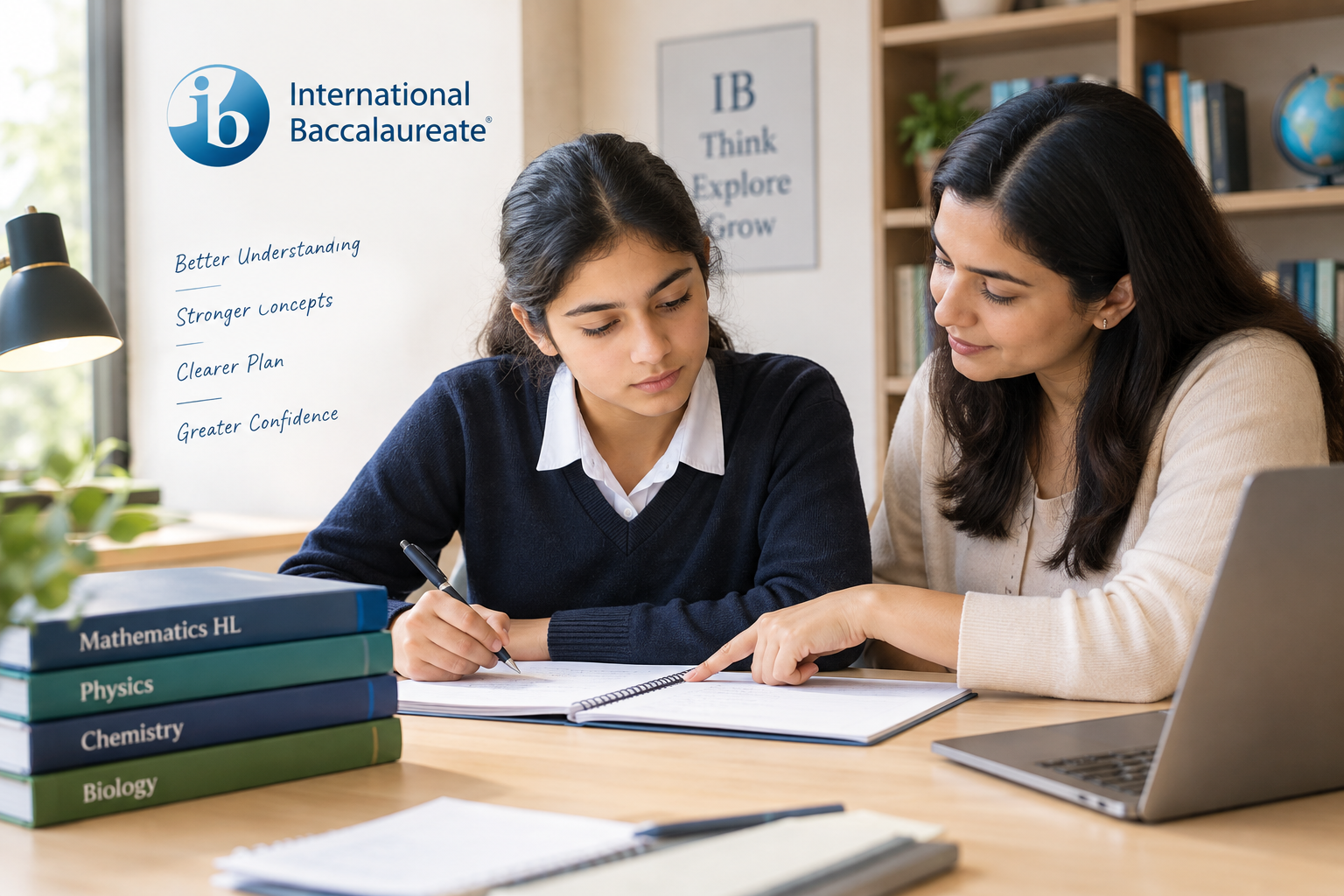
Understanding Why Students Struggle With IB Maths
Before looking for an IB Maths tutor for weak students, it helps to understand what "weak in Maths" actually means. It rarely means a student is incapable of the subject — more often, it means a few specific gaps are quietly affecting everything built on top of them.
Gaps in foundational Maths from earlier years that were never fully closed
Difficulty understanding abstract concepts without a concrete starting point
Classroom lessons moving on before a topic is fully understood
Trouble translating a worded question into mathematical steps
Weak problem-solving habits, such as guessing a method rather than reasoning it out
Not enough guided practice between learning an idea and being tested on it
Difficulty managing longer, multi-step IB-style questions
Unfamiliarity with how IB Mathematics is actually assessed
Lower confidence after a run of low marks or repeated mistakes
Difficulty balancing regular schoolwork with IB Diploma Programme demands
None of this reflects a student's ability to improve. With the right structure and steady, honest feedback, most students who feel weak in Maths can develop a much stronger grip on the subject over time.
How an IB Maths Tutor for Weak Students Can Help
Good IB Maths support isn't about doing the work for the student. It's a process of finding out exactly where understanding breaks down, and rebuilding from there in a structured, patient way.
Identify Learning Gaps
Sessions usually begin by working through a few problems together to see exactly which prerequisite ideas are missing, rather than assuming the whole topic is the issue.
Rebuild the Foundation
Once a gap is found, it's connected back to something the student already understands, so the new idea has something solid to attach to.
Explain Concepts Step by Step
Complex IB Maths problems are broken into smaller, manageable stages, so the student can follow the logic of each step rather than memorising a final method.
Guided Practice
Rather than simply supplying answers, the tutor works through questions alongside the student, asking questions that prompt the student to find the next step themselves.
Correct Mistakes
Recurring errors are noted across sessions, discussed openly, and addressed at the root rather than being corrected the same way every time they appear.
Build Problem-Solving Confidence
As gaps close, students are gradually given more independence, moving from guided questions to attempting similar problems on their own.
Support for Different IB Maths Pathways
An IB Mathematics tutor should adapt their approach to the specific course a student is taking. The two IB Maths pathways — Analysis and Approaches (AA) and Applications and Interpretation (AI) — ask for different kinds of mathematical thinking, at both SL and HL.
IB Maths AA
Analysis and Approaches leans on algebraic reasoning, proof and abstract mathematical thinking. Struggling students often benefit from working through the logic behind each technique, not just the technique itself.
IB Maths AI
Applications and Interpretation focuses on mathematical modelling, real-world applications, data interpretation and appropriate use of technology. Support here often centres on connecting the maths to the context of the question.
IB Maths SL
At Standard Level, structured, consistent support can help students strengthen core concepts, build steady exam technique and approach assessments with more confidence.
IB Maths HL
Higher Level typically asks for deeper conceptual understanding and sustained multi-step problem-solving. Regular, guided practice is often what makes the difference for HL students who are finding the pace difficult.
Course structure and assessment details are set by the IB. For the current IB Diploma Programme Mathematics syllabus, students and parents can refer to the International Baccalaureate official website.
What Personalised IB Maths Tuition Can Cover
Personalised IB Maths tutoring is shaped around the individual student — the exact topics covered depend on their course, their current level, and where their specific learning gaps lie. Commonly covered areas include:
Where relevant, sessions can also help students strengthen the mathematical understanding needed for their Internal Assessment, alongside regular classwork and exam preparation.
A Typical Learning Approach
While every student's plan looks a little different, IB Maths support at Nivara Academy generally follows a clear, honest process:
Understand the Student's Current Level
The first session focuses on understanding what the student already knows, what confuses them, and how they currently approach a problem.
Identify Conceptual Gaps
Specific missing prerequisite concepts are identified, rather than treating the whole subject as equally weak.
Create a Personalised Learning Plan
A plan is built around the student's course (SL/HL, AA/AI), current gaps, and upcoming school deadlines or exams.
Teach Difficult Concepts Clearly
Topics the student finds hardest are explained step by step, using examples the student can relate to.
Practise With Guided Questions
Students attempt questions with support close at hand, so mistakes are caught and corrected while the reasoning is still fresh.
Review Mistakes
Errors are reviewed honestly and calmly, with a focus on the reasoning that led to them, not just the correct answer.
Gradually Increase Question Difficulty
As confidence builds, questions become progressively closer to real IB assessment standard.
Prepare for IB Assessments
Later sessions shift toward timed, exam-style practice, building the pacing and composure needed for actual assessments.
Signs That a Student May Need Extra IB Maths Support
It isn't always obvious when a student has quietly fallen behind. A few common, easy-to-miss signs include:
- Regularly getting stuck on basic steps within a problem
- Avoiding or delaying Maths homework
- Needing help with most questions, even ones covered recently in class
- Understanding a worked example but struggling to solve a similar one alone
- Making the same type of mistake repeatedly
- Difficulty interpreting what a worded problem is actually asking
- Falling gradually behind the pace of classroom lessons
- Noticeably low confidence during tests or quizzes
- Difficulty managing timed practice papers
- Not knowing where or how to start a problem
None of these signs are a judgement on the student — they're simply useful indicators that some structured, personalised IB Maths support could help.
How We Help Students Become More Independent
The purpose of tutoring isn't to permanently solve every problem on a student's behalf. A tutor who does that only creates dependence. The real goal of an IB Maths tutor for weak students is to gradually hand reasoning back to the student, so they can:
Understand, not memorise
Build a genuine understanding of concepts rather than relying on memorised steps.
Choose the right method
Learn to recognise which approach fits a given type of question.
Check their own work
Develop the habit of reviewing and verifying their own answers.
Recognise common errors
Spot the kind of mistakes they personally tend to make, before they happen again.
Approach unfamiliar questions
Feel less thrown by a question that doesn't look exactly like one seen before.
Practise independently
Work through problems confidently between sessions, not just during them.
Why One-to-One Support Can Be Useful
A classroom has to move at the pace of the group. One-to-one IB Maths tuition doesn't. That single difference is often what allows a struggling student to properly catch up rather than fall further behind. It typically offers:
Individual attention, with no competing demands on the tutor's focus
A pace genuinely adapted to how the student learns
Revision targeted at the student's actual weak areas
Immediate clarification when something doesn't make sense
Practice questions chosen for that student's level, not the whole class
Focused, specific feedback rather than general comments
Freedom to revisit a difficult concept as many times as needed
A structured path toward IB Maths exam preparation
Parent Questions: What to Look For in an IB Maths Tutor
Many parents reach out after noticing their child is quietly struggling but aren't sure what actually makes an IB Maths tutor effective. A few useful things to look for:
- Familiarity with the IB Diploma Programme Mathematics curriculum specifically, not just general Maths
- An ability to explain concepts in more than one way, until one of them clicks
- A clear understanding of the student's exact course — SL or HL, AA or AI
- Structured, planned teaching rather than session-by-session improvisation
- A diagnostic approach that identifies gaps before jumping to new topics
- Regular, honest feedback on how the student is actually progressing
- Patient, calm communication, especially with a student who has lost confidence
- A focus on genuine understanding rather than short-term memorisation
- Sensible, realistic preparation for IB Maths assessments
Frequently Asked Questions
Can an IB Maths tutor help a student who is weak in Mathematics?
Yes. An IB Maths tutor for weak students typically starts by identifying exactly which concepts are missing, then rebuilds understanding from there with step-by-step teaching and guided practice.
Is IB Maths tutoring suitable for students who have weak fundamentals?
Yes, this is one of the most common reasons families look for IB Maths support. Weak fundamentals are addressed directly before moving on to more advanced topics, so newer concepts have something solid to build on.
Can you help with IB Maths AA and AI?
Yes. Support is adapted to whichever pathway the student is following — Analysis and Approaches or Applications and Interpretation — since each asks for a different style of mathematical thinking.
Can an IB Maths tutor help with HL as well as SL?
Yes. Both IB Maths SL and IB Maths HL students can receive personalised support, with HL sessions typically placing more emphasis on deeper conceptual understanding and multi-step problem-solving.
How can tutoring help a student who is falling behind?
Tutoring gives a student dedicated time to properly understand topics that were rushed or missed in class, without the pressure of the whole class waiting to move on.
Can personalised IB Maths tuition improve problem-solving skills?
Yes, this is a central part of the process. Rather than only reviewing content, sessions focus on how to approach an unfamiliar problem, choose a method, and reason through the steps.
How often should a struggling IB Maths student have tutoring?
This depends on the student's current level, course demands and upcoming deadlines. A learning plan is usually discussed after the first session, once the student's specific gaps are clearer.
Can tutoring help with IB Maths exam preparation?
Yes. As a student's understanding strengthens, sessions gradually shift toward timed, exam-style questions to build familiarity with the format and pacing of IB Maths assessments.
How does a tutor identify a student's Maths weaknesses?
Usually through a mix of conversation and working through a few problems together in the first session, which reveals where the student's reasoning breaks down.
How can parents enquire about an IB Maths demo class?
Parents can book an IB demo class directly, or reach out on WhatsApp at 8920974351 to ask questions first.
Considering an IB Maths Tutor for Weak Students?
If your child is finding IB Maths difficult, personalised support can give them a structured place to revisit concepts, practise questions properly, and work through learning gaps at their own pace.
WhatsApp: 8920974351
A Calmer Way Forward in IB Maths
Struggling with IB Maths can feel discouraging, but it's rarely a sign that a student can't improve — it usually points to a few specific gaps that haven't been properly addressed yet. An IB Maths tutor for weak students works through those gaps directly: rebuilding foundational Maths skills, explaining difficult concepts clearly, and giving students the guided practice they need to solve problems with more confidence.
At Nivara Academy, IB Maths support is built around the individual student — their course, their current level, and the specific areas where they need the most help. If you'd like to understand how this could work for your child, you're welcome to book an IB demo class or message us on WhatsApp to talk it through first.