
IB Maths Tutor for Students Scoring 4 or 5
One-to-one tutoring built around your actual exam papers and mock results — to find out exactly where marks are slipping, close the gaps behind them, and get you practising the kind of questions that show up in real IB Maths exams.
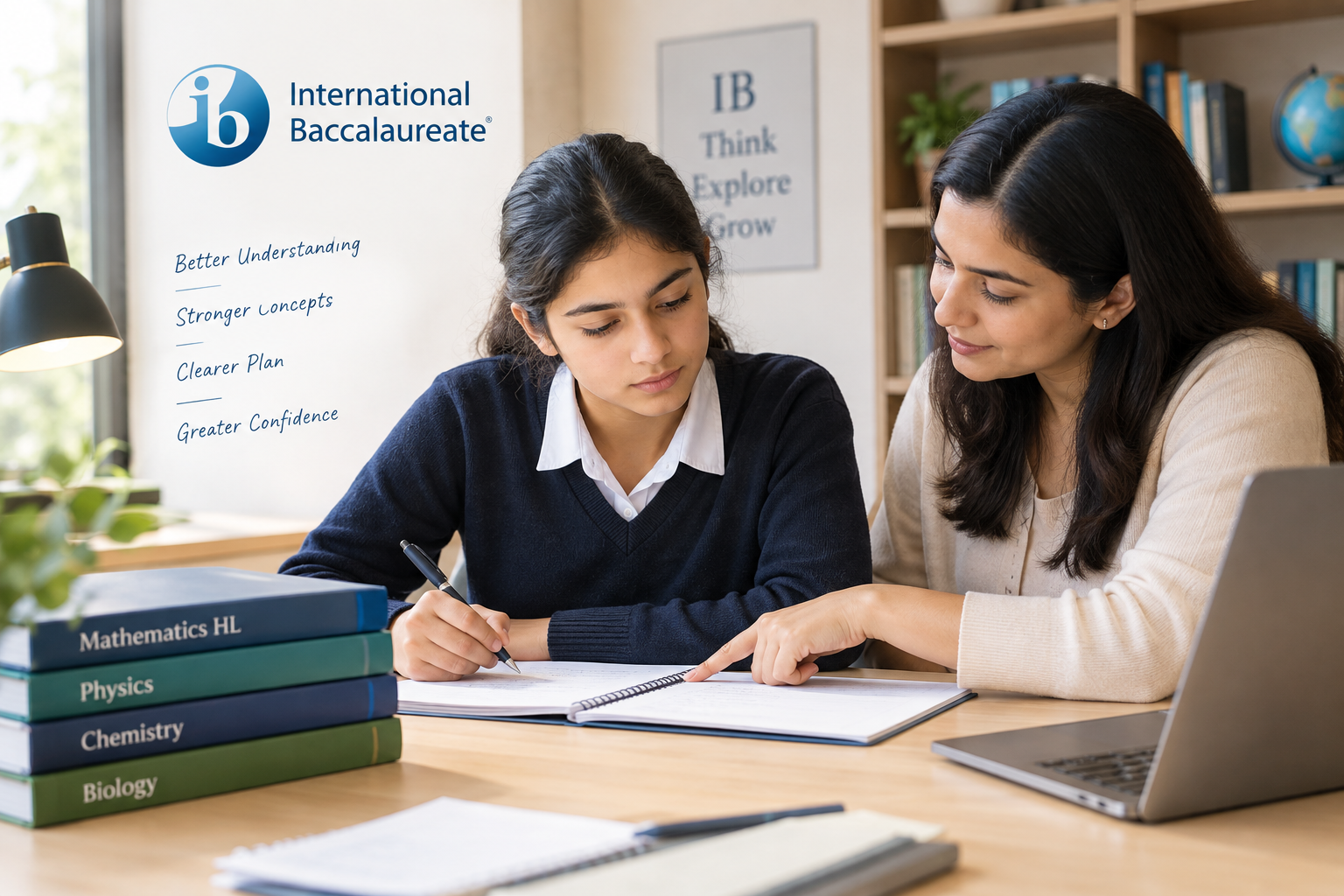
If you're consistently landing on a 4 or 5 in IB Maths, you already know the frustrating part isn't that you understand nothing — it's that you understand more than the grade shows. Maybe the concept made sense in class but fell apart under exam pressure. Maybe you get the first half of a question right and lose the rest to a method you weren't sure about. This is exactly the gap a dedicated IB Maths tutor for students scoring 4 or 5 is built to work on.
At Nivara Academy, we work with IB Diploma Programme students one-to-one, online, to look closely at where marks are actually being lost — not in the abstract, but in your own past papers, your own mock scripts, your own working. From there, tutoring is planned around what will move your grade, rather than repeating a syllabus you've largely already covered.
Why Students Scoring 4 or 5 May Need Targeted Support
A grade 4 or 5 in IB Maths rarely means a student lacks ability. More often, it reflects a specific, fixable pattern — one that's hard to spot on your own but usually obvious once someone sits down and works through your papers with you. Some of the most common things we hear from students include:
None of this points to a lack of ability. It points to gaps in prerequisite knowledge, difficulty applying concepts under exam conditions, unfamiliarity with command terms, inconsistent revision habits, or simply not having had enough practice with IB-style questions specifically. A tutor's job is to work out which of these is actually happening for you — and then address that, rather than re-teaching things you already know.
How One-to-One IB Maths Tutoring Can Help
One-to-one IB Maths tutoring works differently to a classroom, simply because there's no need to pace lessons for thirty students at once. A tutor can slow down exactly where you need it and move quickly through what you've already mastered. Here's what that typically looks like in practice:
Identify current difficulties
Before planning any lessons, we look at your recent tests, mock papers, or class assessments to see exactly where marks are being lost — is it a particular topic, a type of question, timing, or something in how answers are written up?
Review relevant concepts
Where a concept genuinely hasn't clicked, we go back to it properly rather than skimming over it, because shaky foundations tend to resurface later in harder, multi-step questions.
Rebuild missing foundations where necessary
Some gaps go back further than the current topic — a shaky grasp of algebra, for instance, will affect calculus, functions, and vectors alike. Where this is the case, we address it directly rather than working around it.
Work through guided examples
Rather than watching a tutor solve a problem, you work through it with guidance, so you're building the same thinking process you'll need to use independently in the exam.
Practise increasingly challenging IB-style questions
Once the concept is solid, questions get harder in small steps — moving from routine questions toward the kind of multi-part, applied questions IB exams are known for.
Review mistakes carefully
Every mistake gets looked at properly — was it a concept error, a careless slip, a misread question, or a method issue? Each of these needs a different fix, and lumping them together rarely helps.
Develop exam technique
This includes reading command terms properly, showing working in a way that earns method marks, and structuring answers so nothing is lost to presentation.
Use targeted revision
Revision time is directed at your actual weak areas rather than a generic checklist, so the hours you put in are spent where they'll make the most difference.
Monitor progress
We keep track of how you're doing across topics and question types over time, so lessons keep adjusting to where you actually are — not where a fixed plan assumed you'd be.
Adjust future lessons based on performance
If a topic needs more time than planned, or you've moved past something faster than expected, the next lesson reflects that — the plan serves you, not the other way round.
What IB Maths Tutoring With Nivara Academy Covers
The exact topics and depth of coverage depend on your specific IB Maths course and level, but one-to-one lessons are generally built around the core content areas of the IB Diploma Programme Maths syllabus, including:
Not every topic applies in the same way to every IB Maths course — the balance of pure theory versus applied, real-world problem solving is quite different between AA and AI, and HL naturally goes into more depth than SL. Lessons are planned around your specific course rather than a one-size-fits-all syllabus.
Support for IB Maths AA and AI
IB Maths Analysis and Approaches (AA)
AA tends to focus more on abstract mathematical reasoning, algebraic manipulation, proof, and calculus. Students often lose marks here through method errors in longer algebraic questions or by not fully justifying steps that the mark scheme is looking for. Tutoring focuses on tightening up technique and building comfort with more theoretical, multi-step problems.
IB Maths Applications and Interpretation (AI)
AI leans more toward real-world modelling, statistics, and technology-based problem solving. Here, students commonly lose marks by misreading a real-world context, choosing the wrong model, or not interpreting a calculator or software output correctly. Tutoring focuses on translating word problems into correct mathematical setups and interpreting results clearly.
HL and SL Support
Standard Level (SL)
SL students scoring 4 or 5 are often close to consistently higher marks — the gap is frequently about exam technique, timing, or a small number of recurring topic weaknesses rather than a broad struggle with the course.
Higher Level (HL)
HL introduces additional depth and more demanding multi-step questions. A 4 or 5 at HL can also reflect genuinely difficult content, so tutoring often spends more time rebuilding specific foundational concepts before returning to exam-style practice.
Exam Preparation and Revision
A large part of moving beyond a 4 or 5 comes down to how you prepare for the exam itself, not just how well you know the content. Our IB Maths exam preparation work typically includes:
- Past-paper practice under conditions that mirror the real exam, so you build familiarity with pacing and question style.
- Mark-scheme awareness — understanding what examiners are actually looking for, and where method marks are available even if a final answer is wrong.
- Command terms such as "show that," "hence," and "justify," which change what a full answer needs to include.
- Showing working clearly, so partial credit isn't lost to a correct answer with unclear or missing steps.
- Identifying common errors you tend to repeat, so they can be caught before the exam rather than during it.
- Time management across a paper, including which questions to attempt first and when to move on.
- Question selection and reading strategy, particularly for longer, multi-part questions.
- Checking answers efficiently rather than re-solving from scratch.
- Calculator use where relevant to your course and paper.
- Practising unfamiliar and application-style questions, which is often where students scoring 4 or 5 lose the most marks compared to routine questions.
A note on how we approach past papers
The goal of past-paper and IB Maths revision work isn't to memorise answers to specific questions — IB exams are designed so that memorised answers don't transfer well. Instead, we focus on understanding the method behind each question type, so you can adapt when a similar idea appears in a different form.
How Lessons Are Personalised
Every student scoring 4 or 5 is working from a different starting point, so lessons are planned around your own papers and your own patterns of error rather than a fixed course outline. This usually means starting with a review of recent assessments, agreeing which topics or question types need the most attention, and adjusting the plan as you go based on how each lesson goes.
Where useful, we also keep parents informed of progress, so there's a clear picture of what's been covered and what's coming up — without turning tutoring into constant pressure or testing at home.
What a Typical IB Maths Tutoring Plan May Include
- An initial review of recent tests, mocks, or past-paper attempts
- A short discussion of which topics or question types feel hardest right now
- Regular one-to-one online lessons focused on concept clarification and guided practice
- Progressive practice with IB-style and past-paper questions
- Ongoing review of mistakes to catch repeated patterns early
- Exam technique and mark-scheme guidance built into lessons, not treated as a separate add-on
- Periodic check-ins on progress, with the plan adjusted as needed
Why Choose Nivara Academy
Nivara Academy focuses specifically on IB Diploma Programme students, which means lessons are planned with an understanding of what IB Maths exams actually expect — rather than a generic school-maths approach adapted after the fact. Tutoring is one-to-one and online, so lessons can be arranged around your school timetable, and each plan is built individually around your course (AA or AI), your level (HL or SL), and where your marks are currently being lost.
We don't promise a guaranteed grade, and we won't tell you every 4 or 5 is fixed the same way — because it isn't. What we can offer is a structured, honest look at where your marks are going, concept-by-concept clarification where it's genuinely needed, consistent past-paper and mark-scheme practice, and a lesson plan that keeps adjusting based on how you're actually doing.
Who This Tutoring Is Suitable For
Students preparing for internal assessments
Support with the mathematical reasoning and modelling required for IB Maths internal assessment work.
Students preparing for school tests
Targeted revision ahead of regular school assessments in specific units or topics.
Students preparing for mock exams
Structured practice and technique work in the run-up to mock IB Maths exams.
Students preparing for final IB exams
Consolidated revision, past-paper practice, and exam technique in the final stretch before the real thing.
Supporting an IB Maths Student Scoring 4 or 5
How can I tell what my child is actually struggling with? The clearest evidence usually comes from their marked papers — not just the final grade, but where marks were lost within each question. This is exactly what a tutor reviews before starting lessons.
Is a grade 4 or 5 always caused by weak understanding? Not necessarily. It can also come from exam technique, timing, unfamiliarity with command terms, or simply not having practised enough IB-style questions. The right support depends on which of these is actually happening.
Can tutoring help if my child understands the basics but struggles in exams? Yes — this is one of the most common patterns we see, and it responds well to guided practice with past papers and mark schemes, alongside targeted exam technique work.
How does one-to-one tutoring differ from classroom support? A classroom has to move at a pace that works for the whole group. One-to-one lessons can slow down on exactly what your child needs and move quickly past what they've already mastered.
How can I support revision without adding pressure? Keeping communication open about what's being worked on, avoiding additional testing at home, and letting the tutoring plan do the structured work tends to be more effective than extra pressure around results.
If You're the One Sitting the Exam
If you're the student reading this, here's the honest version: a 4 or 5 doesn't mean you're bad at Maths. It usually means something specific is getting in the way of the marks you're capable of — and that's a solvable problem, not a fixed trait. A tutor's job in this situation isn't to lecture you again on things you've already sat through in class. It's to sit with you over your own papers, work out exactly where the marks went, and build a plan around fixing that.
That might mean going back to a concept that never quite settled. It might mean practising a specific question type until it stops feeling unfamiliar. It might mean something as simple as learning to show working in a way that earns method marks even when the final answer isn't perfect. Whatever it turns out to be, it starts with a proper look at where you currently are.
Frequently Asked Questions
Can an IB Maths tutor help a student scoring 4 or 5?
Yes. A tutor working specifically as an IB Maths tutor for students scoring 4 or 5 will look at your past papers and mock results to identify exactly where marks are being lost, then build lessons around closing that specific gap rather than repeating the whole syllabus.
Is tutoring suitable for both IB Maths AA and AI?
Yes. Lessons are planned around your specific course — Analysis and Approaches or Applications and Interpretation — since the two courses differ in emphasis, question style, and common areas where marks are lost.
Do you offer IB Maths SL and HL tutoring?
Yes, tutoring is available for both Standard Level and Higher Level, with the depth and pace of lessons adjusted to match your course.
What if I understand the concepts but lose marks in exams?
This is a very common pattern among students scoring 4 or 5. Tutoring in this case usually focuses on exam technique, mark-scheme awareness, and practising exam-style questions under timed conditions, rather than re-teaching concepts you already know.
Can tutoring help with IB Maths exam preparation specifically?
Yes. Exam preparation is a core part of tutoring, including past-paper practice, command terms, time management, and reviewing recurring errors from your own scripts.
How does one-to-one IB Maths tutoring actually work?
Lessons are held online, one-to-one, and are planned around a review of your recent papers, agreed weak areas, and ongoing adjustment as your tutor sees how you're progressing topic by topic.
Can lessons focus only on my weakest Maths topics?
Yes. Since lessons are one-to-one, time can be concentrated on the topics and question types where you're currently losing the most marks, rather than spreading evenly across the whole syllabus.
Can I get help with IB Maths past papers and mark schemes?
Yes, past-paper practice and mark-scheme review are a regular part of lessons, particularly closer to school tests, mocks, or final exams.
How can parents support an IB Maths student between lessons?
Keeping communication open about what's being covered, avoiding extra pressure or testing at home, and letting the tutoring plan handle the structured revision tends to work best.
How do I book an IB Maths demo class?
You can book a demo class directly through our contact page, or message us on WhatsApp to discuss your current grade and what kind of support might help before committing to lessons.
IB Maths sits within the wider IB Diploma Programme, and students preparing for assessments often find it useful to refer to official curriculum guidance directly from the official International Baccalaureate website alongside their tutoring, particularly when checking formula booklets, assessment criteria, or syllabus updates for their specific course.
Ready to Find Out Where Your Marks Are Going?
If you're currently scoring 4 or 5 in IB Maths, the next step is understanding exactly where marks are being lost and what kind of support would make the biggest difference — not guessing at it alone.