
IB Maths Mathematical Modelling Tutor
Many capable IB students can follow a worked example yet freeze when a question describes an unfamiliar real-world situation. They are unsure what to define, which function to choose, or how to explain what their answer actually means. A dedicated IB Maths Mathematical Modelling Tutor can help your child learn to turn a scenario into mathematics, work with it carefully, and interpret the result in context.
Every session at Nivara Academy is personalised and one-to-one, online. We begin with your child’s IB course, level and questions, and move at a pace that suits them.
Book a Demo Class
Discuss Your Child’s Learning Needs
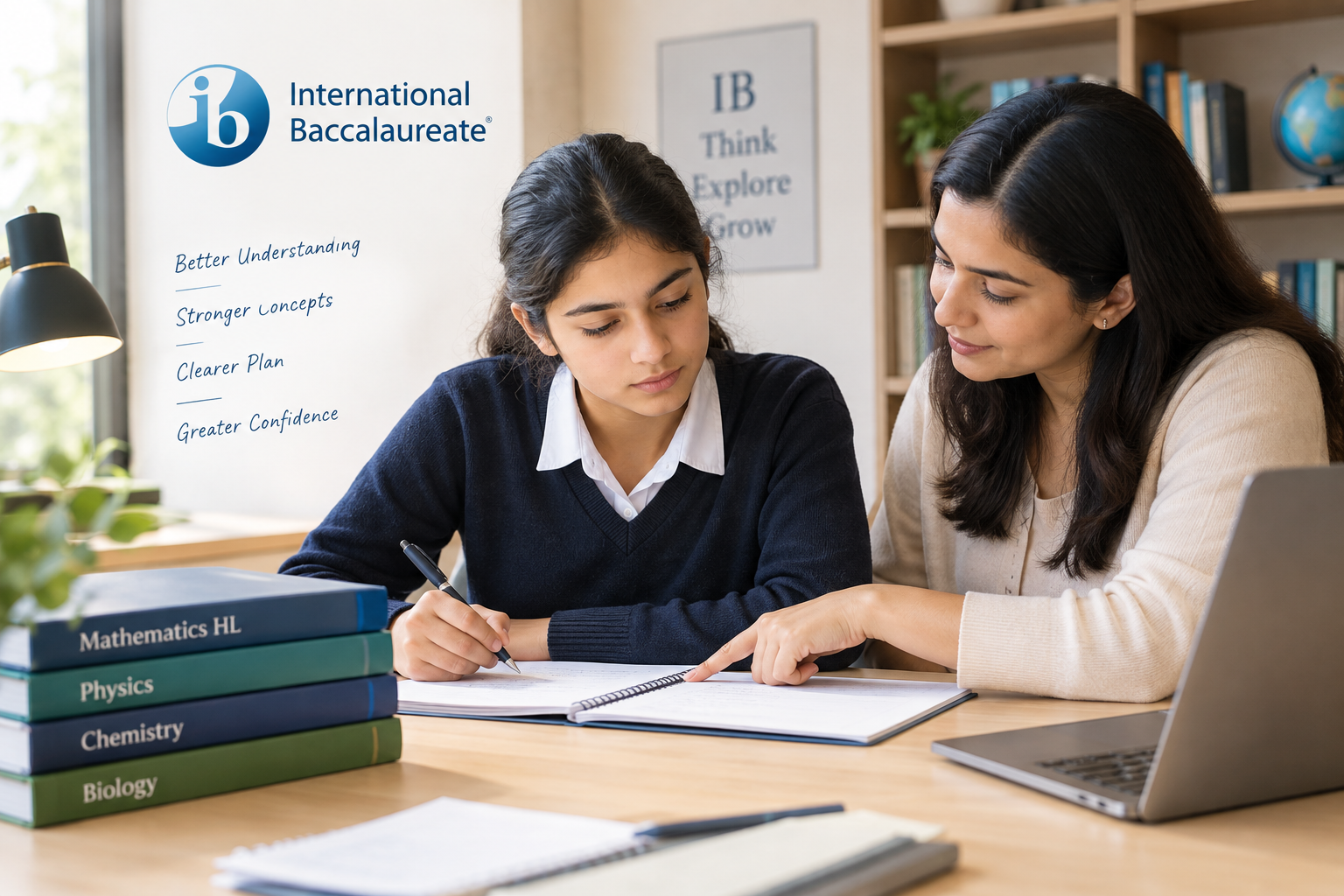
Personalised One-to-One Online IB Maths Tuition
Real data → assumptions → model → interpretation
What Mathematical Modelling Means in IB Maths
Mathematical modelling in IB Maths means representing a real situation with mathematics so that you can analyse it, make predictions and judge how reliable those predictions are. The skill is not only calculating. It involves deciding what to measure, choosing a suitable representation, and explaining the answer in the language of the original problem.
A simple example: planning a taxi fare
Imagine a taxi company charges a fixed starting fee plus a rate for every kilometre travelled. A student working through this might:
- Define variables: let d be the distance in km and C the total cost.
- State assumptions: the rate is constant and traffic delays do not change the price.
- Build the model: a linear function such as C = a + bd, where a is the starting fee and b is the cost per kilometre.
- Use it: estimate the cost of a 12 km journey.
- Interpret and evaluate: what do a and b mean in context? If the company adds a waiting charge or a night-time surcharge, where does the model stop being reliable?
This is an illustration to explain the process. It is not an official IB examination question.
Other situations might be population growth, loan or savings costs, or a cooling drink. In each case the thinking is the same, even though the function changes. You can see how the IB describes its mathematics courses on the official International Baccalaureate website.
Who Can Benefit from an IB Maths Mathematical Modelling Tutor?
Modelling questions ask students to think rather than recall, so it is common to need some individual guidance. Students often benefit when they:
Find word problems hard to start
They read the scenario but are unsure how to turn it into an equation or expression.
Are unsure which variables to use
Choosing what to define, and which equation or function suits the situation, feels like guesswork.
Struggle to interpret outputs
They can produce a graph or a number but find it difficult to say what it means in context.
Need help with assumptions
Explaining assumptions and limitations clearly, and in the right amount of detail, takes practice.
Know formulas but not when to use them
They understand the methods in class yet find it hard to apply them independently to new scenarios.
Want structured IB-style practice
They would like relevant questions, guided explanations and feedback on how they set out their reasoning.
Topics and Skills We Can Work On
Modelling is a way of working that draws on several areas of the course, so it is not a single isolated chapter. Depending on your child’s needs, tuition may focus on:
Variables and assumptions
Deciding what to define, what to simplify, and how to state assumptions clearly.
Formulating relationships
Translating a description into an expression, equation or other representation.
Functions and graphs
Understanding how linear, quadratic, exponential and other function types behave in context.
Interpreting parameters
Explaining what constants, gradients, intercepts and results mean in the real situation.
Making predictions
Using a model to estimate values, and judging whether the result is reasonable.
Evaluating a model
Considering whether a model is appropriate and recognising where it breaks down.
Unfamiliar scenarios
Applying mathematical reasoning when a problem does not resemble a textbook example.
Exam-style problem-solving
Practising relevant questions and presenting clear, well-communicated working.
Technology where required
Using a calculator or other approved technology when the course or task calls for it.
The exact topics depend on your child’s IB Mathematics course, level, current syllabus and learning needs.
Our Personalised Teaching Approach
Support from your IB Maths modelling tutor at Nivara Academy is shaped around one student at a time. It is personalised one-to-one tuition, not a fixed batch-based programme, so the pace and practice follow your child’s needs.
- Understand the starting point. We learn the student’s course, level and the specific difficulties they face.
- Identify gaps. We look for where understanding is missing, whether in earlier topics or in applying methods.
- Break questions into steps. Complex modelling questions become manageable, sequenced stages.
- Demonstrate translation. We show how a scenario becomes mathematics, and explain the reasoning behind each choice.
- Interpret in context. Students learn to explain what an answer means for the original situation.
- Practise with guidance. Relevant questions are worked through with clear explanations.
- Review and build independence. We go over mistakes together and encourage students to solve problems on their own.
Modelling Support for IB Maths AI and AA
Mathematical modelling appears in both IB Mathematics courses. The emphasis and course requirements differ, so tuition follows the student’s actual course and level rather than treating the two as interchangeable.
IB Maths: Applications and Interpretation (AI)
As an IB Maths Applications and Interpretation tutor, we can help students who work with real-world contexts, data and the use of technology. Support often centres on choosing a suitable model, interpreting outputs and commenting on how well a model fits the situation.
IB Maths: Analysis and Approaches (AA)
As an IB Maths Analysis and Approaches tutor, we can help students connect algebraic and analytical methods to applied situations. Support often centres on forming functions and equations, working with them accurately, and interpreting the results.
Modelling is not exclusive to AI, nor irrelevant to AA. Share your child’s course and level when you enquire so that sessions match what they are studying.
Why Consider Nivara Academy?
One-to-one learning
Sessions are personalised, so the focus stays on your child’s course and questions.
Attention to specific questions
Time is given to the exact point a student finds confusing, rather than a general overview.
An appropriate pace
Explanations can be slowed down, revisited or extended as needed.
Practice that fits
Questions are chosen based on current learning needs, not a fixed sequence.
A supportive space to ask
Students can ask questions openly without worrying about holding up a class.
Flexible, from home
Online sessions let students learn from home, wherever they live.
Looking for an IB Maths Mathematical Modelling Tutor?
Your enquiry is a chance to talk through your child’s needs. It helps if you can share:
- IB course (AI or AA)
- Level (SL or HL)
- Current difficulties
- Learning goals
We will use this to discuss how one-to-one tuition could support your child.
Frequently Asked Questions
What does mathematical modelling mean in IB Maths?
It means using mathematics to represent a real situation, so you can analyse it and make predictions. Students define variables, state assumptions, choose a suitable function or equation, solve it, and then explain what the result means in context. A good model is also evaluated: students consider where it might not match reality.
Can an IB Maths Mathematical Modelling Tutor help with word problems?
Yes. Many students find the mathematics manageable but struggle to begin. A tutor can show how to read a scenario carefully, pick out the quantities involved, decide which are variables, and write them as an equation or expression. With practice, students build a routine they can apply to unfamiliar problems.
Is mathematical modelling relevant to IB Maths AI and AA?
Yes, though the emphasis and requirements differ between the courses and between SL and HL. For that reason, tuition is based on the student’s own course and syllabus. Please check your school’s guidance and the official IB resources for exact course requirements.
Can online tuition help students understand modelling questions?
It can. In a live one-to-one session, a tutor can work through a problem step by step, sketch graphs, and respond immediately when the student is unsure. Students can also share their own working so that feedback focuses on their reasoning, not just the final answer.
How can students improve their interpretation of mathematical models?
Interpretation improves when students practise linking every number back to the situation. For instance, asking what a gradient, intercept or growth rate represents, including its units. It also helps to ask whether an answer is reasonable and to write one or two clear sentences explaining it. Guided practice with feedback makes this habit stronger.
Can a tutor help students practise IB-style modelling questions?
Yes. A tutor can select practice questions relevant to the student’s course and level, work through them with explanations, and help students set out their reasoning clearly. Mistakes are reviewed so that students understand not only what went wrong but how to approach a similar question next time.
How is one-to-one IB Maths tuition personalised?
Sessions begin with the student’s course, level and current difficulties. The pace, explanations and practice are then adjusted to what the student needs, whether that means revisiting a concept, working through more examples, or moving on to less familiar problems. It is not a fixed batch programme.
How can parents arrange a demo class with Nivara Academy?
Parents can use the Nivara Academy demo enquiry page to share the student’s IB course, level, difficulties and goals. The enquiry is an opportunity to discuss the student’s needs and how personalised online tuition could help.
Ready to Talk About Your IB Maths Learning Needs?
Tell us what your child is studying and where they feel stuck, and we can discuss how one-to-one online support might help.