
IB Maths Application Questions Practice Guide
Application questions give you a situation, not an instruction. Instead of "solve this equation", you get a story about a tank, a loan or a tide, and you have to decide what the mathematics is. That is why so many students who know their formulas still lose marks. This IB Maths Application Questions Practice Guide shows you how to read an unfamiliar question, choose a method, use your GDC sensibly and explain the result in context.
Talk to Nivara Academy About Your IB Maths Goals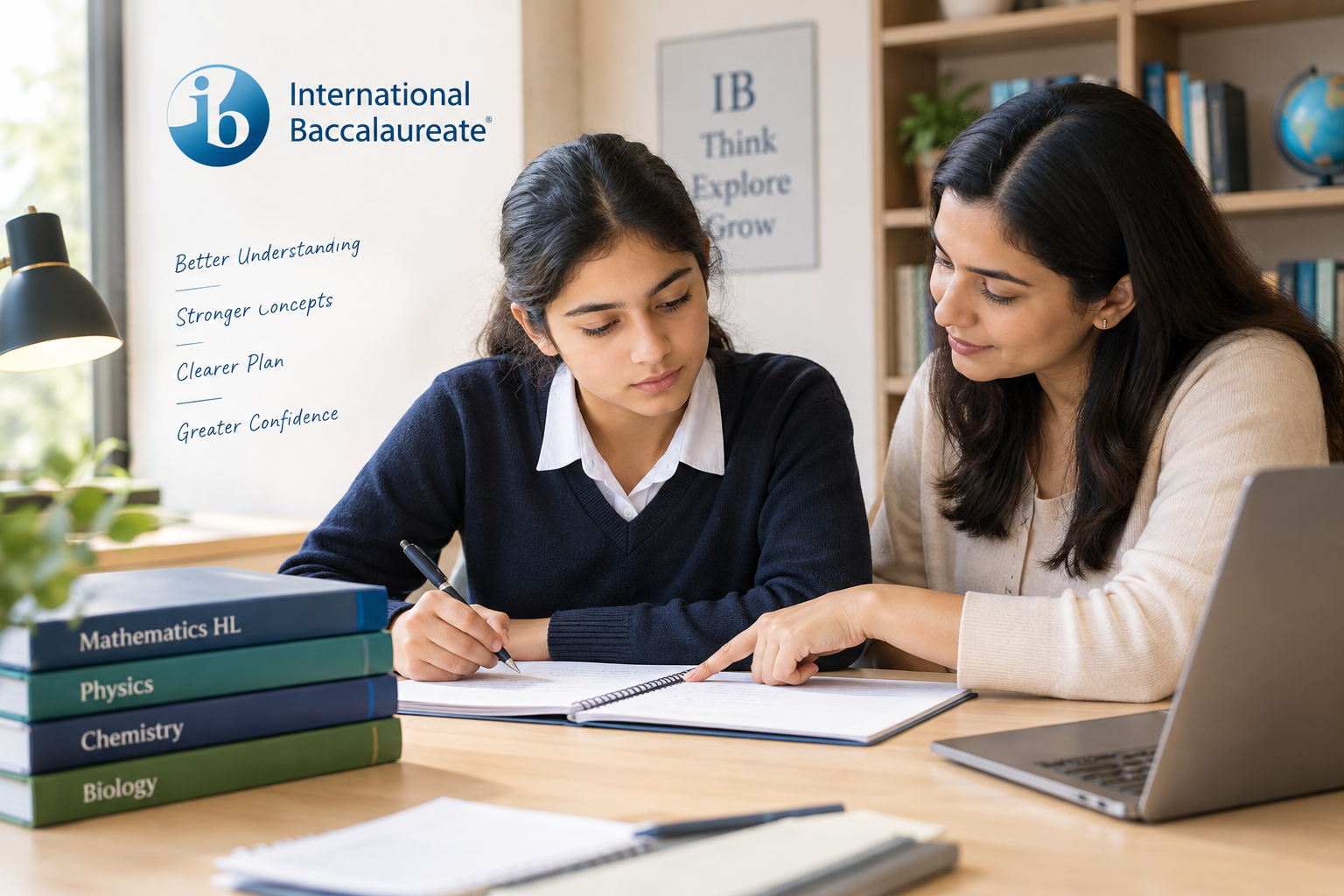
What Are IB Maths Application Questions?
What Are IB Maths Application Questions?
IB Maths application questions place a mathematical idea inside a context. You are expected to pull out the useful information, turn the words into mathematics, choose a suitable method, calculate, and then say what the answer means. Typical skills include:
Read and select
Identify which numbers and conditions matter and which are just background.
Translate
Define variables and turn sentences into equations, functions or diagrams.
Choose and connect
Pick a method, sometimes combining several ideas, and use technology where it helps.
Interpret and communicate
Explain the result with units and show reasoning a marker can follow.
Why Do IB Maths Application Questions Feel Difficult?
Most students are not struggling with the mathematics itself. They struggle with everything around it:
- Unfamiliar wording and too much information. A paragraph of data hides the one relationship you need.
- Not knowing what is being asked. Many students start calculating before they can say what the final answer will be.
- Method uncertainty. Knowing a formula is different from knowing when it applies.
- Combining concepts. A question may need a function, then a derivative, then an interpretation.
- Graphs, tables and modelling. Reading data, stating assumptions and judging a model's limits are skills of their own.
- GDC uncertainty. Some students use it blindly, others avoid it when it would save time.
- Correct number, lost marks. A right answer with no units, no context or unclear working often does not earn full credit.
This is the reason a student can finish a textbook exercise comfortably and still feel lost in an exam-style question. The textbook tells you the topic; the exam does not.
IB Maths Application Questions Practice: A Step-by-Step Method
A repeatable routine removes the panic of an unfamiliar question. Use these ten steps in practice until they become automatic.
- Read before you touch the calculator. Read the whole question once for the story, then again for the details.
- Identify what is known. Underline values, units, conditions and any given function or table.
- Identify what must be found. Read the final sentence carefully. "Find the time" and "find the maximum height" lead to different answers.
- Translate into mathematics. Define variables, sketch a diagram, or write the relationship as an equation or function.
- Decide which concept applies. Ask: is this growth, a rate of change, a distribution, a geometric relationship? Name the idea before choosing the formula.
- Set up clearly. Write the equation or expression you will use, with substitutions visible.
- Use the GDC when appropriate. Solving, graphing, table of values or statistics functions are fine, but record what you entered and what it returned.
- Check the result. Is it the right size? Positive when it should be? In the right units?
- Interpret in context. Turn "n = 5.39" into "the bike drops below 500 USD during the sixth year, so after 6 full years".
- Present the final answer. State it in a sentence, with units and the requested accuracy, and avoid rounding early.
How to Practise IB Maths Application Questions Effectively
"Do more questions" is incomplete advice. A better IB Maths application question practice system moves through stages:
- Guided questions first. Start with structured questions that show how a context becomes mathematics.
- Mixed questions. Once topic-by-topic work feels comfortable, mix topics so you must decide the method yourself.
- Unfamiliar contexts. Deliberately practise settings you have not seen. This trains transfer, which is what exams test.
- Reduce support gradually. Remove hints, notes and formula sheets as confidence grows.
- Time selected questions. Not every session needs a stopwatch, but some should be under exam conditions.
- Keep an error log. Record the question type, what went wrong and the fix. Review it weekly.
- Explain your method choice. After each question, write one line on why that method fitted.
- Revisit weak concepts. If the same topic keeps causing errors, go back to the underlying skill, not just more application.
The quality of review matters far more than the count of questions finished. Related support: IB Maths Online Tuition and IB Maths Score Improvement Program.
Practice by Question Type
Topics and emphasis differ between IB Maths AA and AI, and between SL and HL, so check your own syllabus. These are common styles to practise.
Real-world context
Practise extracting a mathematical model from a short story, then stating what the answer means.
Multi-step
Write a brief plan first (for example "find the equation, then solve, then interpret") so no step is forgotten.
Data and graphs
Describe trends, read values carefully, and comment on reliability or limits.
Mathematical modelling
State assumptions, fit or use a model, then judge whether predictions are sensible.
Financial and percentage
Distinguish simple from compound change, and watch the compounding period and rounding.
Geometry and measurement
Draw and label diagrams, track units, and choose between trigonometry, area or volume tools.
Functions and algebra
Link equations to graphs, find intercepts and turning points, and say what they mean in the situation.
Probability and statistics
Identify the distribution or event structure, then interpret probabilities in words.
Calculus
Connect derivatives to rates and optimisation, integrals to accumulation, and always check the context.
GDC-based
Practise efficient graphing, solving and statistics commands, and write down the setup you used.
For topic-specific help: IB Maths Functions Tutor · IB Maths Trigonometry Tutor.
IB Maths AA vs IB Maths AI Application Questions
Both Mathematics: Analysis and Approaches (AA) and Mathematics: Applications and Interpretation (AI) expect you to apply ideas, not just recall them. The difference is largely in flavour and emphasis.
| Course | How application thinking often shows up |
|---|---|
| AA | Contexts often lean on algebraic reasoning, functions, calculus and proof-style thinking, where a clear analytical argument matters. |
| AI | Contexts often lean on modelling, data, statistics and technology, where interpreting results and using the GDC well matter. |
This is a general picture, not a promise about any particular paper. For exact content, assessment structure and weighting, rely on the Official International Baccalaureate website and your school's current subject guide.
IB Maths SL and HL Application Practice
HL application questions are not simply SL questions with bigger numbers. Differences tend to appear in:
- Connected steps: HL tasks may chain more ideas together.
- Depth of reasoning: you may need to justify, generalise or work with less scaffolding.
- Unfamiliar settings: the context may be further from what you have practised.
- Communication: at both levels, clear notation and explanation earn marks.
SL students should build secure habits (define, set up, interpret). HL students should add multi-concept practice and practise explaining why a method works, not only that it does.
Common Mistakes Students Make
| Mistake | Fix |
|---|---|
| Calculating before understanding | Say in one sentence what you must find before writing any numbers. |
| Grabbing a formula too fast | Name the concept first, then choose the formula. |
| Ignoring units or not defining variables | Write "let t = time in hours" and carry units through. |
| Calculator used blindly | Write the equation you are solving before entering it. |
| Answer with no interpretation | End with a sentence that answers the question in context. |
| Rounding early / ignoring accuracy requests | Keep full values on the GDC and round once at the end as asked. |
| Not checking realism | Ask: could a bike really be worth negative dollars? |
| Skipping working or missing the final sentence | Show key steps, and reread the last line before finishing. |
How to Analyse an IB Maths Application Question You Got Wrong
After a mistake, work through these questions in writing:
- What was the question testing?
- What information did I miss or misread?
- Did I choose the wrong concept?
- Was it an algebra or arithmetic slip?
- Did I misuse my GDC?
- Did I forget to interpret the answer?
- What will I do differently next time?
Ten carefully reviewed questions usually teach more than thirty rushed ones, because the review shows you which habit to change.
Mini Practice Examples: IB Maths Application Questions Practice Guide in Action
These are original examples written for practice, not taken from IB papers. Try each one before opening the solution.
Example 1: Percentage change
A bike worth 1,200 USD loses 15% of its value each year. After how many whole years is it first worth less than 500 USD?
Show solution
Model: V = 1200(0.85)ⁿ. Solve: 1200(0.85)ⁿ < 500, so n > 5.39 (GDC or logarithms). Check: n = 5 gives about 532.5 USD, n = 6 gives about 452.6 USD. Answer: after 6 years. The bike falls below 500 USD during year 6, so 6 is the first whole year where it is below.
Example 2: Trigonometric model (GDC)
The depth of water at a harbour is d = 6 + 2.5 sin(πt/6) metres, where t is hours after noon. For how long is the depth above 7.5 m during the first 6 hours?
Show solution
Solve 6 + 2.5 sin(πt/6) > 7.5, so sin(πt/6) > 0.6. Graph both sides on the GDC and find intersections: t ≈ 1.23 and t ≈ 4.77. Check: the maximum depth is 8.5 m at t = 3, between the two values, which makes sense. Answer: the depth exceeds 7.5 m for about 3.54 hours.
Example 3: Optimisation
A farmer has 40 m of fencing and builds a rectangular pen using a wall as one side, so only three sides need fencing. What dimensions give the largest area?
Show solution
Let x be each side perpendicular to the wall, so the side parallel to the wall is 40 − 2x. Area A = x(40 − 2x) = 40x − 2x². Then dA/dx = 40 − 4x = 0, so x = 10. This is a maximum because A is a downward-opening quadratic. Answer: 10 m by 20 m, giving a maximum area of 200 m².
How Nivara Academy Helps Students Practise IB Maths Application Questions
Nivara Academy provides personalised 1-to-1 online IB Maths tuition. With individual support, a tutor can see how you actually think through a problem, not only whether the final answer was right. That helps with:
- spotting recurring application-question mistakes
- practising at the right level and building a structured plan
- understanding why a particular method is used
- improving reasoning, notation and written explanations
- working through unfamiliar problems with feedback
- preparing for IB Maths assessments and exams
We do not promise grades. We focus on helping you practise in a way that fits your course, level and gaps. Depending on your goal, see IB Maths Tutor for Students Targeting a 7 or IB Maths Tutor for Students Scoring 4 or 5.
Talk to Nivara Academy About Your IB Maths Goals
Book a personalised IB Maths consultation/demo with Nivara Academy and discuss how 1-to-1 online IB Maths support could fit your child's or your own situation.
Book a Personalised IB Maths ConsultationIB Maths Application Questions: Frequently Asked Questions
What are IB Maths application questions?
They are questions where mathematics is set inside a real or modelled situation. You must identify the useful information, build a mathematical representation, choose a method, calculate (often with a GDC) and interpret the result in context, rather than simply follow a direct instruction.
How can I practise IB Maths application questions?
Start with guided questions, move to mixed topics, then try unfamiliar contexts with fewer hints. Use the ten-step method, keep an error log, and time some questions. Reviewing why you chose a method matters more than the number of questions completed.
Why can I solve textbook questions but struggle with IB exam questions?
Textbook exercises usually announce the topic and repeat one method. Exam questions often do not. You must decide what the question is about, which means practising mixed and unfamiliar problems, not only topic-by-topic drills.
How do I improve my IB Maths problem-solving skills?
Build a routine: read carefully, define what is known and unknown, name the concept, set up clearly, check the result and interpret it. Then practise it consistently on varied questions and learn from every error rather than moving on quickly.
Are IB Maths application questions different for AA and AI?
Both courses require applying mathematics. AA often leans towards algebraic and analytical reasoning, while AI often leans towards modelling, data and technology. Exact content differs, so check your subject guide on the official IB website and with your teacher.
How should HL students practise application questions?
HL students should add multi-concept problems, less scaffolded questions and practice explaining why a method works. Focus on connecting topics, justifying steps and communicating clearly, instead of only attempting longer or harder-looking questions.
How important is GDC practice for IB Maths application questions?
It matters, particularly for solving equations, graphing, statistics and checking models. But the GDC supports your thinking; it does not replace it. Practise the commands you need and always write down the equation or setup you entered.
How can I stop making mistakes in unfamiliar IB Maths questions?
Slow down at the start. Restate what is being asked, define variables, and check units and realism at the end. Log each mistake by type (misread, wrong concept, algebra, GDC, interpretation) so you can target the habit behind it.
How many IB Maths application questions should I practise each week?
There is no single correct number. A few carefully reviewed questions across several sessions often works better than a large rushed batch. Choose a manageable amount, include some unfamiliar and timed questions, and spend as long reviewing as attempting.
Can 1-to-1 IB Maths tuition help with application questions?
It can, because a tutor can watch your reasoning, find recurring patterns and give feedback at your level. It works best alongside your own regular practice. Results depend on the student, so Nivara Academy does not guarantee any specific grade.