
IB Maths AI SL Tutor for Exam Preparation
Nivara Academy works with IB Diploma students one-to-one, online, to prepare for IB Mathematics: Applications and Interpretation SL exams. Sessions are built around your syllabus progress, past-paper performance and the specific topics costing you marks, rather than a fixed course everyone follows in the same order.
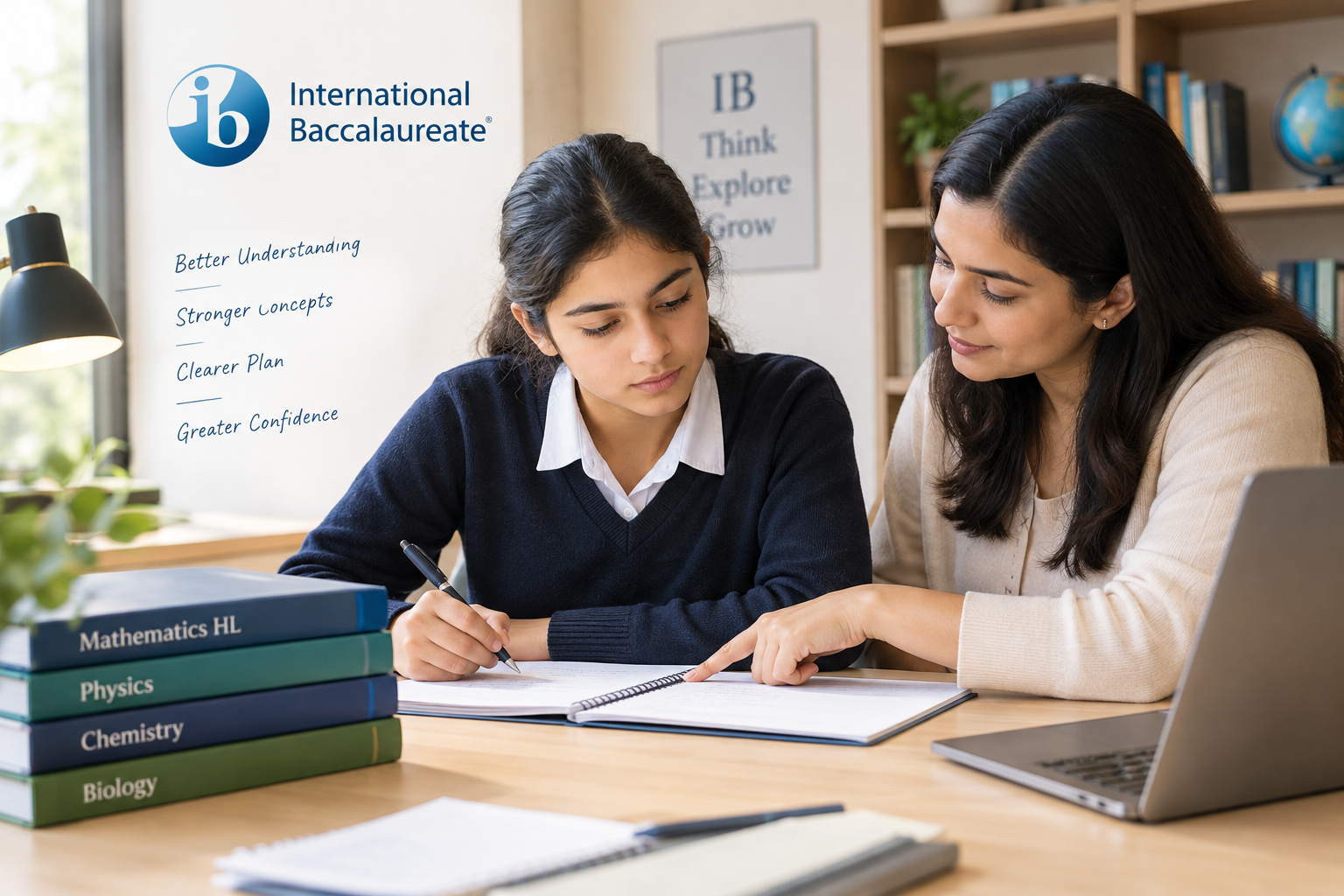
What IB Maths AI SL Exam Preparation Actually Involves
IB Maths AI SL exam preparation is rarely about learning brand-new content in the final few months. For most students, it is about turning two years of syllabus coverage into something they can reliably reproduce under exam conditions. That process usually starts with an honest look at the syllabus as it stands today, checking which topics are genuinely secure and which ones only feel secure because they haven't been tested properly yet.
A tutor's first job in IB Maths AI SL exam preparation is usually diagnostic: working through a mix of topics to see where a student's understanding breaks down, and whether the issue is the maths itself or how the question is being read. Many students who "know the topic" still lose marks because they misread a command term, skip a step the mark scheme expects to see, or run out of time before reaching a question they could have answered.
From there, preparation typically moves through a cycle of reviewing concepts that are shaky, practising exam-style questions on those concepts specifically, and then testing the same ideas again in a slightly different format to confirm they've actually stuck. Accuracy tends to improve faster once a student stops re-doing topics they already understand and starts spending time where the marks are actually being lost.
Timed practice is introduced gradually rather than from day one. Early sessions often focus on method and understanding without a clock running, so a student can think clearly and ask questions. Timed conditions are added once the underlying maths is solid, because timing pressure on top of shaky understanding usually just produces more mistakes rather than better ones.
Reviewing mistakes is arguably the most underused part of exam preparation. Going through a paper and marking it is not the same as understanding why each error happened — whether it was a slip, a misread question, an incomplete method, or a genuine gap in knowledge. A tutor's role is often to slow this step down so it becomes a source of real improvement rather than just a score.
Why Students Choose an IB Maths AI SL Tutor for Exam Preparation
Students reach out for IB Maths AI SL tutoring for very different reasons, and none of them mean a student is "behind" in any lasting sense. IB Maths AI SL covers a wide range of topics — from statistics and probability to financial mathematics and modelling — and it's entirely normal to feel confident in some areas and unsure in others as exams approach.
Specific topics feel unclear
Some students understand most of the course but consistently get stuck on particular topics, such as hypothesis testing, correlation, or certain modelling questions, and want focused help closing that gap.
Revision has fallen behind
Between internal assessments, other subjects and school deadlines, revision can slip. A tutor can help rebuild a realistic plan for the time that's actually left before exams.
Exam-style questions feel different
Understanding a concept in class doesn't always translate to answering a multi-step exam question that combines several ideas at once, especially longer Paper 2 style questions.
Repeated calculation errors
Some students consistently lose marks to avoidable slips — rounding too early, calculator input errors, or misreading their own working — rather than a lack of understanding.
Uncertainty over which method to use
AI SL often allows more than one valid approach to a problem. Some students hesitate over which method the question is really asking for, which costs time in the exam.
Time pressure in the exam
Running out of time, or spending too long on one question and rushing the rest, is one of the most common issues raised by students preparing for AI SL papers.
None of these situations are unusual, and none of them require a student to overhaul how they learn. Most of the time, one-to-one IB Maths AI SL tutoring is simply about narrowing down exactly where marks are being lost and working on that directly, rather than re-teaching the whole syllabus from scratch.
What We Cover in IB Maths AI SL Exam Preparation
IB Maths Applications and Interpretation SL is built around a small number of broad topic areas, and exam preparation sessions are generally organised around these. Exact syllabus content and assessment structure can be updated by the IB from time to time, so a tutor should always work from the current syllabus and your school's own guidance rather than assuming every detail stays the same year to year.
Number and algebra
Working with sequences, exponents, logarithms and algebraic manipulation as a foundation for later topics.
Functions
Reading graphs, understanding transformations, and applying different function types to modelling contexts.
Geometry and trigonometry
Applying geometric reasoning and trigonometric relationships to practical and applied problems.
Statistics
Data collection, representation, measures of spread and centre, and correlation between variables.
Probability
Working through probability distributions and applying them to realistic scenarios seen in exam questions.
Financial mathematics
Applying mathematical tools to interest, depreciation, and other real-world financial contexts.
Mathematical modelling
Building and interpreting models, and evaluating how well a model fits a given real-world situation.
Data interpretation
Reading tables, graphs and data sets accurately, and drawing appropriate conclusions from them.
Technology-supported work
Using a GDC confidently and accurately where calculator use is expected as part of the assessment.
Sessions don't need to move through these areas in a fixed order. A tutor will usually prioritise whichever topics are closest to your upcoming exams, or wherever your own practice papers suggest marks are currently being lost.
Exam-Focused One-to-One IB Maths AI SL Tutoring
Classroom teaching has to move at a pace that works for an entire group, which means individual gaps don't always get the time they need before the class moves on. One-to-one IB Maths AI SL tutoring works differently: a session can spend as long as necessary on a genuinely difficult idea, or move quickly through material a student has already mastered.
Personalised explanations
The same concept can be explained in more than one way until it makes sense to that particular student, rather than relying on a single explanation for everyone.
Individual pacing
Sessions move at whatever speed is right for the student on that topic, on that day — sometimes faster than a classroom, sometimes slower.
Targeted practice
Practice questions are chosen based on where a student is currently losing marks, rather than working through every question in a textbook chapter.
Immediate feedback
Mistakes are picked up and corrected in the moment, rather than a week later once a marked paper comes back.
Flexible online scheduling
Sessions are arranged around school timetables, IA deadlines and other commitments, since exam preparation has to fit around a busy IB schedule rather than compete with it.
Ongoing revision planning
A tutor can adjust the plan session to session as exams approach, based on how a student's practice-paper performance is actually changing.
From Syllabus Review to Exam Practice
While every student's plan looks slightly different, IB Maths AI SL exam preparation with Nivara Academy generally follows a similar sequence:
Assess current understanding
An initial conversation and some sample questions establish where a student currently stands across the syllabus.
Identify knowledge gaps
Specific topics or question types that consistently cause problems are identified rather than treating the whole syllabus as equally weak.
Prioritise important areas
Gaps are ranked by how soon they're likely to be tested and how heavily they're weighted in the exam.
Review concepts
Weaker topics are re-taught properly, with time given to questions rather than rushing to "cover" the material.
Practise guided questions
A student works through questions with support available, so mistakes can be caught and explained straight away.
Move to independent questions
Support is gradually reduced so a student can confirm they can solve similar questions without prompting.
Analyse mistakes
Errors from independent practice are reviewed to understand whether they were slips, misreads, or genuine gaps.
Complete timed practice
Once accuracy is reasonably solid, timed conditions are introduced to build speed and exam stamina.
Review past papers
Full or partial past papers are used to simulate real exam conditions and surface any remaining weak spots.
Refine exam technique
Final sessions focus on technique — time allocation, command terms, and how to approach the exam paper as a whole.
Using IB Maths AI SL Past Papers and Exam-Style Questions Effectively
Past papers are one of the most valuable resources for IB Maths AI SL exam preparation, but only when they're used deliberately. Simply completing paper after paper without reviewing the results tends to reinforce existing habits rather than fix them, including bad ones.
- Learning question patterns. Working through several years of exam-style questions helps students recognise how a given topic tends to be assessed, and which command terms usually accompany it.
- Understanding command terms. Words like "state," "show that," "hence," and "justify" each carry a different expectation for how much working needs to be shown, and misunderstanding them is a common source of lost marks.
- Practising under time limits. Timed sections build the pacing instinct needed to complete a full paper without rushing the final questions.
- Checking working. Reviewing whether each step of a solution is clearly shown, not just whether the final answer is correct.
- Reviewing mark schemes. Mark schemes reveal exactly where credit is given, which is often more specific than students expect.
- Understanding where marks are earned. Method marks, accuracy marks and follow-through marks each work differently, and knowing this changes how a student approaches a question.
- Learning from incorrect answers. Wrong answers are often more instructive than correct ones, provided the underlying reason for the mistake is properly understood.
- Avoiding repeated mistakes. Keeping a simple record of recurring error types helps a student notice patterns across multiple papers rather than treating each mistake as a one-off.
For copyright reasons, official IB exam questions cannot be reproduced here or in general marketing material. Tutoring sessions work directly from officially published past papers and specimen materials, alongside carefully constructed exam-style practice questions.
Improving IB Maths AI SL Exam Technique
Strong exam technique often makes as much difference to a final score as additional content knowledge, particularly for students who already understand the maths but don't always convert that understanding into marks.
Read the full question first
Rushing into a calculation before reading the whole question is a common reason students answer something slightly different from what was actually asked.
Identify exactly what's being asked
Underlining or noting the specific quantity a question wants can prevent answering with the wrong unit, variable or level of precision.
Show appropriate working
Even where a calculator gives the final answer, mark schemes usually expect the method to be visible on the page.
Check calculator inputs
A single mistyped value can produce a confident, entirely wrong answer, so a quick sense-check of inputs is worth the extra seconds.
Check units where relevant
Financial and modelling questions in particular often penalise answers given with missing or incorrect units.
Estimate whether an answer is reasonable
A rough mental estimate can catch an error immediately, before time is lost moving on to the next question.
Manage time deliberately
Allocating roughly how many minutes each question deserves, based on the marks available, helps avoid running out of time late in the paper.
Move on and return later
Getting stuck on one question for too long is one of the most common ways students lose marks elsewhere in the same paper.
Review answers before submitting
Where time allows, a final pass to check units, rounding and whether every part of a question has been answered can recover easy marks.
Who Can Benefit From This Tutoring?
Students struggling with IB Maths AI SL
Students who find the pace of the classroom difficult to keep up with, or who feel unsure across large parts of the syllabus, often benefit from a slower, more structured re-introduction to key ideas.
Students who understand concepts but lose marks in exams
Some students genuinely know the material but consistently underperform in test conditions due to technique, timing, or misreading questions rather than a lack of knowledge.
Students preparing for upcoming exams
Whether preparing for a mock exam, an end-of-topic test, or the final IB exams, focused sessions can help consolidate revision in the time available.
Students who need structured revision
Students who find it hard to organise their own revision, or who aren't sure where to start, often benefit from an outside structure and clear priorities.
Students wanting additional exam practice
Some students are performing reasonably well already and simply want more exam-style practice and feedback to push their marks further.
Students who need one-to-one online support
For students without easy access to in-person tutoring, or who prefer working from home, online one-to-one sessions offer the same level of individual attention remotely.
Building a Personalised IB Maths AI SL Revision Plan
A useful revision plan is built from real information about a student, not a generic template applied to everyone preparing for the same exam. A tutor typically draws on several factors when building or adjusting one:
Current performance
Recent test results and classwork give a starting picture of where a student stands right now.
Upcoming exam date
How much time is realistically available shapes how ambitious or focused the plan needs to be.
Strong and weak topics
Time is allocated in proportion to how much a topic needs, rather than spread evenly across the whole syllabus.
Past-paper performance
Actual results on practice papers are often more revealing than a student's own sense of which topics feel hardest.
Recurring errors
Patterns of repeated mistakes are addressed directly, since they tend to cost more marks over time than isolated one-off errors.
Available study time
A workable plan has to fit realistically around school, IA deadlines, and other subjects, not compete with them.
A simple example of how this might come together over several weeks:
Weeks 1–2
Diagnostic review across the syllabus, and identifying the two or three topics needing the most attention.
Weeks 3–5
Focused concept review and guided practice on priority topics, moving to independent questions as confidence builds.
Weeks 6+
Timed past papers, mistake analysis, and technique refinement in the run-up to exams or mocks.
This is one illustrative structure, not a fixed formula — an actual plan will vary depending on how much time is available and how a student is progressing.
Why One-to-One Online IB Maths AI SL Tutoring?
Online one-to-one tutoring removes some of the practical barriers that make in-person tutoring difficult to arrange consistently, while keeping the individual attention that makes one-to-one support useful in the first place.
- Individual attention. A session is built entirely around one student's needs, with no need to share time or pace with a group.
- Flexible scheduling. Sessions can be arranged around a student's own timetable, including different time zones for students studying outside their home country.
- Online accessibility. Students can access consistent, individual support regardless of where they live, without needing a tutor to travel or be based nearby.
- Personalised lessons. Each session builds on the last, rather than following a fixed syllabus schedule unrelated to a student's actual progress.
- Focused exam practice. Screen-sharing and digital whiteboards make it straightforward to work through exam-style questions and mark schemes together in real time.
- Direct feedback. Mistakes and misunderstandings can be addressed immediately rather than waiting until a marked paper is returned.
Why Nivara Academy?
Nivara Academy focuses on one-to-one tutoring for IB Diploma and MYP students, with an emphasis on understanding each student's actual coursework, syllabus version and school context rather than teaching to a generic curriculum.
Sessions are built around the subject a student is actually studying — in this case, IB Mathematics: Applications and Interpretation at SL — and are adapted as a student's needs change across a term or academic year. Because tutoring is one-to-one, lessons can move at whatever pace suits a particular student, whether that means slowing down to properly rebuild a weak topic or moving quickly through material a student has already mastered.
Communication between the tutor, student and parents is treated as part of the process rather than an afterthought, so that everyone involved has a clear, realistic sense of how preparation is progressing as exams approach.
Nivara Academy is an independent tutoring provider. It is not affiliated with, endorsed by, or acting on behalf of the International Baccalaureate Organization.
What a Typical IB Maths AI SL Tutoring Session Can Look Like
While every session is adapted to what a particular student needs on a given day, a typical IB Maths AI SL tutoring session with Nivara Academy tends to follow a loose, flexible structure:
- Quick review of previous work. A short check-in on how homework or independent practice went since the last session.
- Identify the day's goal. Agreeing what the session needs to focus on, whether that's a specific topic, a set of exam-style questions, or exam technique.
- Explain or revise a concept. Working through the underlying maths clearly, at whatever pace is needed for it to make sense.
- Work through examples together. Guided questions with support available at each step.
- Attempt exam-style questions. Moving toward more independent practice once the concept feels secure.
- Analyse mistakes. Going through anything that went wrong and understanding exactly why, rather than simply providing the correct answer.
- Set focused practice for next time. A small, specific set of questions to reinforce what was covered before the following session.
Sessions can shift away from this structure entirely when needed — for example, spending an entire session purely on past-paper practice and mark-scheme review in the weeks before an exam.
Parents: What to Look for in an IB Maths AI SL Tutor
Choosing tutoring support for the IB Diploma is different from choosing tutoring for a national curriculum, since the assessment style, command terms and internal structure of the course are specific to the IB. A few things are worth checking when looking for an IB Maths AI SL tutor:
- Familiarity with the IB curriculum. A tutor should understand how Applications and Interpretation SL is structured and assessed, rather than treating it as generic school mathematics.
- Ability to explain concepts clearly. Look for a tutor who checks understanding rather than simply working through problems at speed.
- Understanding of exam-style assessment. Familiarity with command terms, mark schemes and how marks are actually awarded matters as much as subject knowledge itself.
- Personalised teaching. Sessions should be shaped around your child's specific gaps and goals, not a fixed, identical course for every student.
- Clear communication. You should have a reasonable sense of what's being covered and how your child is progressing, without needing to ask repeatedly.
- Structured revision. A tutor should be able to explain, at least in outline, how sessions build toward the exam rather than covering topics at random.
- Appropriate use of practice material. Past papers and exam-style questions should be used thoughtfully, with proper review, rather than simply assigned in bulk.
- Progress monitoring. There should be some way of tracking whether a student's understanding and exam performance are actually improving over time.
Frequently Asked Questions
What does an IB Maths AI SL tutor do for exam preparation?
An IB Maths AI SL tutor typically starts by assessing a student's current understanding across the syllabus, then builds a plan that reviews weak topics, practises exam-style questions, and gradually introduces timed conditions as exams approach. The exact focus shifts depending on how much time is left and where a student is currently losing marks.
Is IB Maths AI SL tutoring suitable for students who are struggling?
Yes. One-to-one tutoring is often particularly useful for students who are finding the pace of the classroom difficult, since sessions can slow down and rebuild specific concepts properly rather than moving on before a topic is secure.
Can a tutor help with IB Maths AI SL past papers?
Yes. Past papers and mark schemes are a core part of exam preparation. A tutor can help a student work through officially published past papers, understand where marks were lost, and review mark schemes to see exactly how credit is awarded.
Can tutoring help me improve my exam technique?
Exam technique — reading questions carefully, showing appropriate working, managing time, and checking answers before moving on — is a regular focus in tutoring sessions, particularly for students who understand the maths but underperform in test conditions.
How early should I start IB Maths AI SL exam preparation?
There's no single correct starting point, since it depends on a student's current level and how confident they feel across the syllabus. Some students prefer to start well before their final exams to spread revision out gradually, while others begin closer to mock exams. Starting earlier generally allows more time to properly address weaker topics rather than relying on last-minute practice.
Can lessons focus only on my weakest topics?
Yes. Because tutoring is one-to-one, sessions can concentrate specifically on the topics or question types causing the most difficulty, rather than working through the entire syllabus at an even pace.
Is online one-to-one IB Maths AI SL tutoring effective?
Online one-to-one tutoring can be effective when sessions are genuinely tailored to a student's needs, with clear goals, active practice, and regular review of mistakes. Tools like screen-sharing and digital whiteboards make it straightforward to work through exam-style questions together in real time.
Can a tutor help me create a revision plan?
Yes. A tutor can help build a revision plan based on your current performance, exam date, strong and weak topics, and available study time, and adjust it as your practice-paper results change.
Can IB Maths AI SL tutoring help with calculator-based questions?
Yes. Where calculator use is relevant to a question, sessions can cover how to use a GDC accurately and efficiently, including checking inputs carefully so a single typing error doesn't lead to a confidently wrong final answer.
Can I prepare for IB Maths AI SL exams through one-to-one tutoring?
Yes, one-to-one tutoring is a common way for IB students to prepare for AI SL exams, particularly where a student wants sessions focused specifically on their own gaps rather than a fixed group course.
How does an online IB Maths AI SL tutoring session work?
A typical session involves a quick review of previous work, a clear goal for the day, explanation or revision of a concept, guided and then independent practice questions, mistake analysis, and a small set of focused practice questions to complete before the next session.
How can I book an IB tutoring demo with Nivara Academy?
You can book an IB demo class directly through the "Book an IB Demo Class" button on this page, or send a message via WhatsApp to discuss your current level and preparation needs before arranging a session.
For official information on the IB Diploma Programme and current subject guides, students and parents can refer to the official International Baccalaureate website. Nivara Academy is an independent tutoring provider and is not affiliated with the IB.
Prepare Smarter for Your IB Maths AI SL Exams
If you're not sure where to start, a short initial conversation is usually the easiest first step. You can talk through your current level, upcoming exam dates, and what you'd like preparation to focus on, and take it from there at your own pace.