
IB Maths Probability Tutor
One-to-one help for students who want to understand probability, choose the right method and write exam answers that earn marks. Parents get a clear, structured way to support it.
- Personalised IB Maths support, paced to your child
- Clear explanations of concepts, not just formulas
- Exam-style probability questions with feedback
- Support shaped around your IB Maths course and level
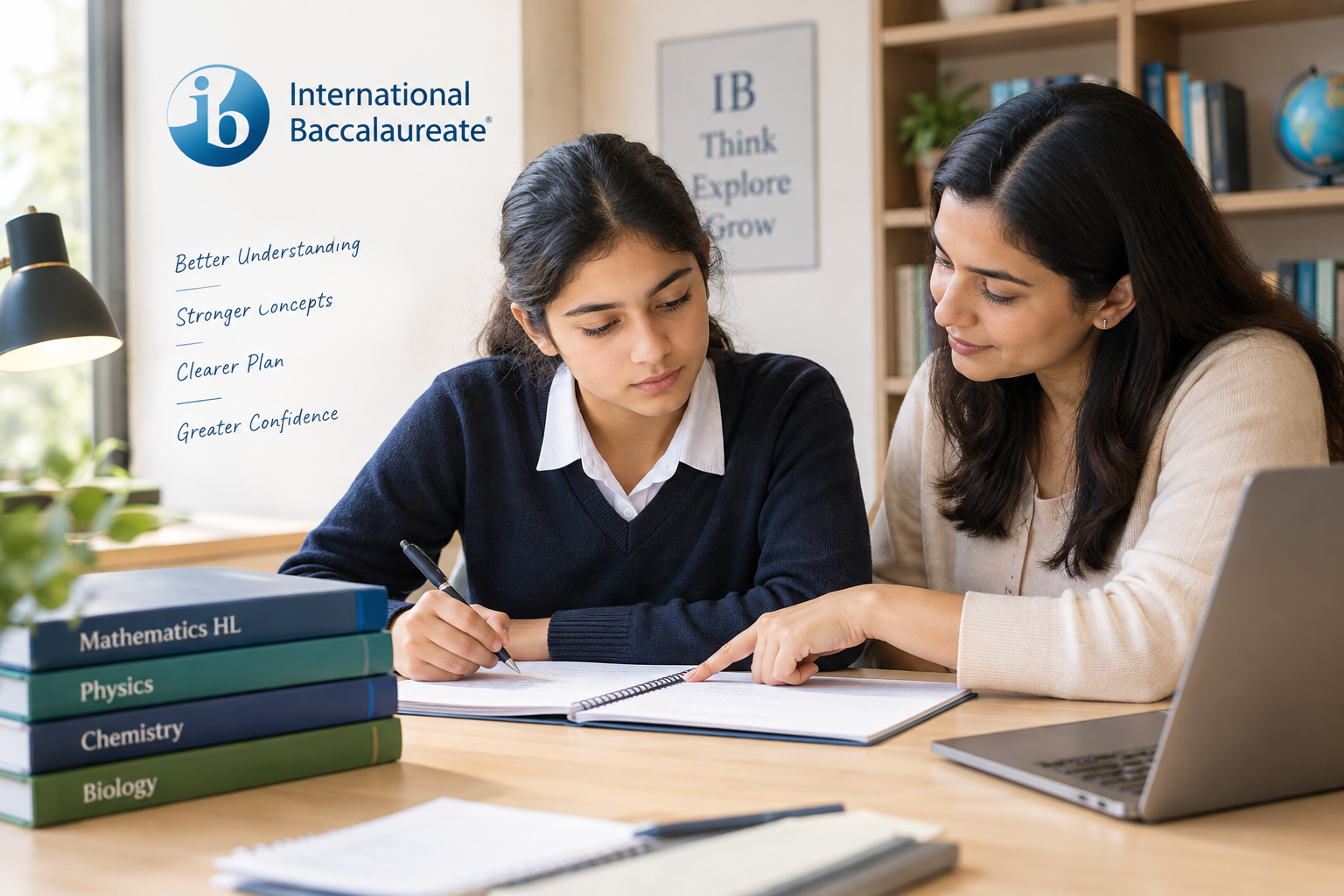
Why students look for an IB Maths probability tutor
Probability is one of the areas of IB Mathematics where a student can follow every step in class and still feel lost on the next question. The formulas are short. The difficulty is deciding which one applies.
A good IB Maths Probability Tutor slows that decision down. Together you read the question, identify what is being asked, choose a model and check the answer makes sense. When classroom pace does not leave room for that, one-to-one time can.
Who this page is for
IB Maths students who feel unsure about probability, and parents who want to understand how tutoring could help. You do not need to know your exact syllabus details to get in touch. Tell us your course and current topic and we will take it from there.
What an IB Maths Probability Tutor can help with
IB Maths probability tutoring is not only extra explanation. It covers four things that tend to decide marks.
Understanding concepts
Why a rule works, so it can be applied to a new situation instead of memorised for a familiar one.
Reading questions
Turning wording such as "given that", "at least" or "without replacement" into the correct mathematical setup.
Choosing a method
Deciding between a tree diagram, a Venn diagram, a table, a distribution or a calculator function.
Writing answers
Showing working clearly, using correct notation and checking that a probability lies between 0 and 1.
Probability topics students may need support with
Exact coverage depends on your course, level and school scheme of work. These are the areas we most often work through in IB Maths probability support.
Foundations
- Sample spaces and events
- Complementary events
- Mutually exclusive events
- Combined events
Independence and conditioning
- Independent and dependent events
- Conditional probability
- Probability trees
- Venn diagrams and tables
Counting and structure
- Counting principles where relevant
- With and without replacement
- Multi-step problems
- Organising information before calculating
Distributions
- Discrete probability distributions
- Expected value
- Variance and standard deviation where relevant
- Binomial probability where applicable
Normal distribution
- Probability calculations from a normal model
- Interpreting the answer in context
- Calculator use where your course allows
Statistical reasoning
- Interpreting probability information
- Translating word problems into models
- Checking whether an answer is reasonable
Not every topic above belongs to every IB Maths course. If a topic is outside your syllabus, we will not spend your time on it.
Why probability feels harder than it looks
These are the kinds of difficulties students describe most often. Most come from question interpretation rather than weak maths.
Probability rewards careful reading. A single phrase can change independence to dependence, or "and" to "or", and the whole answer changes with it. That is why explaining the reasoning aloud, with someone who can spot exactly where it slips, tends to help more than more worked solutions to read.
How one-to-one probability tutoring works
Every student starts in a different place, so the sequence below adapts to pace and need.
- Find the difficult topicsThrough a demo class and a look at recent work, we identify where understanding breaks down.
- Review current understandingWe check what the student already does well so time is not spent re-teaching it.
- Explain step by stepConcepts are built up with diagrams, examples and plain language.
- Work through examples togetherThe tutor models how to read, set up and solve a question, then hands over more of the thinking.
- Move to independent problem solvingGuided questions gradually become questions the student attempts alone.
- Practise exam-style questionsQuestions are chosen to match your course and the style of IB assessment.
- Review mistakes and communicationWe look at why marks were lost, including notation, layout and unclear working.
Sessions are paced to the student. Some need more time on conditional probability, others on distributions or exam technique. We do not promise particular grades, because results depend on many factors, including the student's own practice.
IB Maths AA, AI, SL and HL probability support
Probability help looks different depending on the course, so we start by asking about it.
Course: AA or AI
IB Maths Analysis and Approaches and Applications and Interpretation approach content and questions differently. Support for IB Maths AA probability may lean on algebraic reasoning, while IB Maths AI probability often involves interpreting data and using technology.
Level: SL or HL
HL students may meet extended content and more demanding multi-step reasoning. SL students may need a firm grip on core methods. We do not assume either.
Your school context
The topic you are studying now, your school's pacing and any upcoming test all shape what we work on first.
Individual weak spots
Two students in the same class can need different things. Support follows the gaps, not a fixed script.
When you enquire, mention your course, level and current probability topic. For official course information, see the International Baccalaureate website.
Probability exam preparation and question solving
Tutoring aims to build understanding and problem-solving ability. Memorising formulas alone rarely survives an unfamiliar question.
Exam-style and past-paper practice
Working through IB Maths past-paper style questions shows what examiners expect and where your own patterns of error sit.
Question patterns and command terms
We look at how probability questions are usually built and what words such as "find", "show that" and "hence" require in the answer.
Working and accuracy
Showing suitable working, avoiding avoidable calculation slips and checking answers for sense before moving on.
Time management
Deciding how long a question deserves and when to move on and return.
Choosing the right method
Learning the signals that point towards conditional probability, a binomial model or a normal distribution.
Reviewing mistakes
Every error is sorted into misreading, method, arithmetic or presentation, so revision targets the real cause.
Unfamiliar questions become less alarming once the student has a reliable routine: read, sketch, define events, choose a method, calculate, check.
How Nivara Academy tutoring can help
Nivara Academy provides personalised academic tutoring, and sessions are adapted to the student's course, current level and learning needs. For probability, that means we begin with your questions and your school work instead of a generic worksheet.
The demo class is a chance to see how a session feels, discuss the topics causing trouble and decide whether ongoing support makes sense. There is no pressure to continue.
Start With an IB Demo ClassWhat a typical session can include
- A quick review of the last piece of work or question set
- Focused explanation of one probability topic
- Worked examples, then guided practice
- An exam-style question attempted independently
- Feedback on method, working and notation
- Short follow-up practice before the next session
What students and parents can expect
For students
- Clearer understanding of when and why methods apply
- More confidence reading probability word problems
- A space to ask questions without holding the class up
- Practice that is matched to their level
For parents
- A clear picture of which topics are being covered
- Sessions tied to the school syllabus and upcoming assessments
- Honest feedback about progress, without guarantees
- An easy first step through a demo class
Talk to an IB Maths Tutor about probability
Tell us your course, level and the topics that feel shaky. We will help you decide what a useful first session looks like.
Want background on the programme? Learn more about the International Baccalaureate →
IB Maths Probability Tutor: frequently asked questions
What does an IB Maths Probability Tutor help with?
A tutor helps with understanding probability concepts, reading questions correctly, choosing a method, practising exam-style questions and writing clear working. Support is matched to your course and the topic you are currently studying.
Can I get help with conditional probability?
Yes. Conditional probability is one of the most common sticking points. We work on recognising when the condition changes the sample space, and use tree diagrams, tables and Venn diagrams to make the reasoning visible.
Can a tutor help with IB Maths probability exam questions?
Yes. Sessions can include exam-style questions, review of command terms, and feedback on working and notation, so the student learns how marks are earned as well as how to reach an answer.
Is probability tutoring available for IB Maths AA and AI?
Yes. Content and emphasis can differ between the two courses, so please share which one the student is studying. We then focus on what is relevant to that syllabus.
Can I get help at SL or HL?
Yes. Support is adapted to the level. Some HL students need help with multi-step reasoning, while some SL students need core methods secured first.
Can tutoring focus only on probability?
Yes. Many students come to us with one topic in mind. If other areas of IB Maths need attention later, we can discuss that separately.
Can you help me understand probability word problems?
Yes. We practise breaking a question into events, identifying what is given and what is asked, and translating the wording into a mathematical model before any calculation begins.
Can tutoring include past-paper practice?
Yes. Past-paper style practice is a regular part of exam preparation. We review the mistakes afterwards so that practice leads to improvement, not only repetition.
Can I get help if I understand the theory but keep losing marks?
Yes, and this is common. Marks are often lost through misreading, missing working, rounding or unclear notation. We look at your actual answers to find the pattern and fix it.
How can I book an IB Maths demo class?
Use the Book an IB Demo Class button on this page, or message us on WhatsApp. Share the student's course, level and the probability topics they find difficult, and we will suggest a suitable first session.
Get personalised IB Maths support
If probability is holding back your IB Maths progress, an IB Maths Probability Tutor can help you work out where the confusion starts and how to fix it.