
IB Tutor for Last Minute Exam Preparation
Exams close and too much syllabus left? Work one-to-one with a tutor who helps you decide what to revise first, clear up the concepts that keep tripping you up, practise real exam-style questions, and read a markscheme the way an examiner does.
Tell us your subject, level (HL or SL) and exam date — we will tell you honestly what can be covered in the time you have.
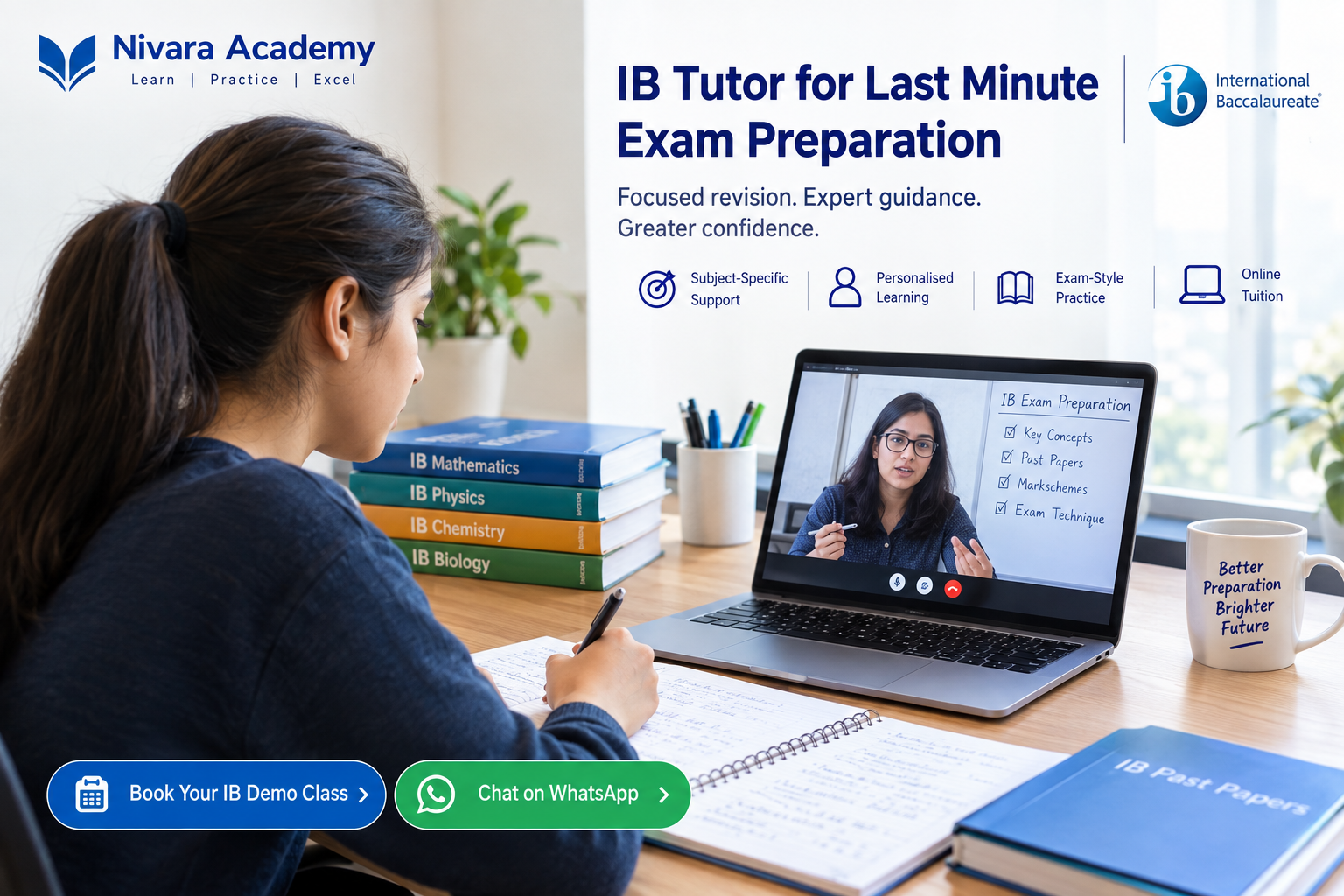
- Subject-focused IB tuition
- Personalised revision support
- Exam-style question practice
- Online classes for IB students
- Clear updates for parents
What last minute IB exam preparation actually means
It is not a crash course that replaces two years of the Diploma Programme. It is a decision about where your remaining hours go.
Most students who come to us a few weeks before their papers are not starting from zero. They have sat through the lessons, made some notes, and completed most of the coursework. What they usually do not have is a clear picture of which topics are still weak, and which of those weak topics are actually worth the revision time.
That is the real job of an IB last minute exam preparation tutor. Not to re-teach the whole course, but to look at your syllabus, your recent mock or class performance, and the number of days left, then help you spend that time where it will make the most difference.
There is a genuine difference between relearning everything from scratch and closing specific gaps. Relearning from scratch is slow, it feels productive because you are always busy, and it often leaves the hardest material untouched because you never reach it. Closing gaps is uncomfortable — you go straight at the topic you have been avoiding — but it is far more efficient when time is short.
Using the remaining time well usually means shorter, sharper sessions with a defined outcome: one sub-topic understood, one question type practised, one set of mistakes reviewed. Reading a chapter for two hours rarely produces that. Attempting past paper questions, marking them honestly and then fixing what went wrong does.
Understanding still matters, even now. IB papers regularly place a familiar idea in an unfamiliar context, so a student who has memorised steps without knowing why they work tends to stall the moment the question is phrased differently. Memorisation has its place — definitions, command term meanings, key structures — but it works best sitting on top of understanding, not instead of it.
A good revision plan at this stage is short, specific and revisable. If something is not working after a few days, you change it rather than pushing on out of habit.
How our IB exam revision tuition works
Five steps, kept deliberately simple so no time is wasted on setup when exams are close.
Understand your subject, level and exam timeline
We start with the practical details: which subject, Higher Level or Standard Level, which papers you are sitting, and exactly how many study days remain. A student with five weeks and a student with nine days need different plans, and pretending otherwise helps nobody.
Identify difficult topics and knowledge gaps
Your tutor works through a short diagnostic — a few targeted questions, a look at recent mock papers or class tests, and a conversation about which topics you quietly dread. Students are often accurate about what they find hard; the gaps they miss are usually the ones they think they understand.
Build a focused revision plan
We then map topics against the time available and put them in order, with the high-weight, high-difficulty material first while you are freshest. You get a plan you can actually follow between sessions, not a colour-coded timetable that collapses on day three.
Practise exam-style questions and past papers
Sessions move quickly into IB past paper practice, because answering questions under realistic conditions exposes far more than re-reading notes. We look at how the question is worded, what the command term is asking for, and how the marks are distributed across the answer.
Review mistakes, sharpen technique, prepare for the paper
Every attempted question gets reviewed against the markscheme so you can see where marks were earned and where they slipped away — a missing unit, an unsupported statement, a definition that was close but not creditworthy. In the final stretch we shift towards timing, paper strategy and steadying nerves.
IB subjects we support
Tuition is offered for IB Diploma Programme subjects at Higher Level and Standard Level. Availability depends on the subject, level and tutor timetable, so please confirm your specific course with us before booking.
IB Mathematics Analysis & Approaches · Applications & Interpretation · HL & SL
Work through the topics that cost marks — calculus, functions, probability and statistics — with attention to method marks, correct notation and using the formula booklet efficiently under time pressure.
IB Physics HL & SL
Clarify the concepts behind the equations, practise multi-step calculations with units and significant figures, and build a reliable approach to data-based and extended response questions.
IB Chemistry HL & SL
Focused revision across bonding, energetics, equilibrium, organic mechanisms and calculations, plus practice with the data booklet and the phrasing examiners expect in explanation questions.
IB Biology HL & SL
Tighten up terminology and process detail, learn to structure longer answers around command terms, and practise interpreting unfamiliar data, graphs and experimental setups.
IB Economics HL & SL
Revise core theory and diagrams, practise applying models to real contexts, and work on evaluation — the part of extended response answers where marks are most often left behind.
IB Business Management HL & SL
Strengthen tool and concept recall, practise case study analysis, and learn to build balanced, well-structured recommendations rather than description-heavy answers.
IB English Language & Literature · Literature · HL & SL
Practise unseen text analysis, develop a workable essay structure, and sharpen the way you use evidence and comment on the writer's choices rather than summarising the text.
IB Psychology HL & SL
Organise studies and theories so they are usable in an exam, practise linking research to the question asked, and work on structured responses with clear critical discussion.
Other IB subjects
Tell us your subject and level and we will confirm whether a suitable tutor is available for your exam timeline. If we cannot support your course properly, we will say so rather than take the booking.
Why students look for an IB tutor before exams
The reasons are usually practical rather than dramatic. These are the ones we hear most often.
A few topics never clicked
There is often one chapter that was rushed in class or missed during an absence, and it has quietly stayed unresolved ever since.
Exam-style questions feel different
The content makes sense in the textbook, but the way IB papers phrase questions feels unfamiliar, and confidence drops as soon as marks are involved.
Revision time is hard to manage
Six subjects, coursework deadlines and a fixed exam timetable make it difficult to judge how long to spend on anything.
Long answers are unclear territory
Students know the content but are unsure how much to write, how to structure it, or what an evaluation or discussion actually requires.
No one is checking the work
Practising alone without feedback means the same mistake can be repeated for weeks without anyone pointing it out.
Applying concepts under pressure
Understanding a topic calmly at home is not the same as recognising it inside an unfamiliar question with the clock running.
What an IB tutor can help you revise
The balance between these areas depends entirely on your subject, level, syllabus and how much time is left — a student nine days out works differently from one with six weeks.
- Core concepts and difficult chapters. The material that everything else depends on, plus the topics you have been quietly avoiding.
- Formulas and where they come from. Knowing which relationship to reach for, when it applies, and how to use the formula or data booklet efficiently.
- Definitions and key terminology. Precise wording matters in the sciences, economics and psychology, where a vague definition simply does not earn the mark.
- Data analysis and calculations. Reading graphs and tables accurately, handling units and significant figures, and showing method clearly.
- Structured and extended responses. Planning longer answers so they address the command term instead of drifting into description.
- Past paper practice. Working through IB-style questions in realistic conditions, then reviewing them properly rather than just checking the final answer.
- Markscheme awareness. Seeing how marks are allocated across an answer so you know when to stop writing and when more detail is genuinely needed.
- Time management within a paper. Allocating minutes per question, deciding what to attempt first, and knowing when to move on.
- Exam technique. Setting out working, labelling diagrams, and answering the question that was asked rather than the one you hoped for.
- Reviewing recurring mistakes. Keeping a short record of errors so the same marks are not lost twice.
Why students and parents choose Nivara Academy
We would rather be clear about how we work than make promises about results we cannot control.
Lessons built around one student
Classes follow your gaps and your exam dates. Nothing is delivered from a fixed script that ignores what you already know.
Subject-specific tutors
You are matched with a tutor for your subject and level rather than a generalist covering everything at once.
Flexible online classes
Sessions are scheduled around school, coursework and time zones, which matters most in the weeks when the timetable is tight.
Exam-focused from the first session
Concepts are taught in the context of how they are examined, so revision and exam practice happen together rather than in sequence.
Structured gap analysis
Weak areas are identified through questions and marked work rather than guesswork, and the plan is updated as things improve.
Open communication with parents
Parents receive a straightforward picture of what is being covered and what still needs work, without inflated reassurance.
Placeholder for Nivara Academy to complete: add verified details here before publishing — tutor qualifications and teaching background, number of years the academy has been operating, class formats and session lengths, fee structure, and any genuine reviews collected with student or parent permission. Do not publish numbers, ratings or results that cannot be evidenced.
Who this IB revision tuition suits
A good fit if you are
- Sitting IB Diploma Programme examinations soon and want structured support.
- Comfortable with most of the course but stuck on a few difficult topics.
- Looking for focused revision rather than general, open-ended tuition.
- Studying an HL subject that has moved faster than you expected.
- Confident with content but losing marks on exam-style questions.
- Unsure how to organise the revision time you have left.
- A parent seeking subject-specific IB tuition and an honest assessment of where your child stands.
When a longer plan makes more sense
Last minute revision works best when there is something to revise. If large parts of the syllabus have never been covered, or if a subject has been difficult from the beginning of the course, a few urgent sessions will not fix that — and we will tell you so at the enquiry stage rather than after payment.
In that situation a longer programme over several months, or a decision taken with your school about subject level, is usually the more sensible route. Students in Year 1 of the Diploma, or those preparing for mock examinations with more time in hand, generally benefit from steady weekly tuition instead.
If you are unsure which of the two describes your situation, a demo class is the quickest way to find out.
Ten last minute IB exam preparation tips that actually help
Useful whether or not you work with a tutor.
- Start from the syllabus, not your notesOpen the subject guide and mark each topic as secure, shaky or untouched. Your notes tell you what you wrote down; the syllabus tells you what can be examined.
- Rank by difficulty and weight togetherA hard topic that appears on every paper deserves more time than an easy one that rarely does. Put the demanding material early in the day.
- Practise questions before you feel readyWaiting until a topic feels complete usually means never practising it. Attempting questions while still shaky is how the gaps become visible.
- Review mistakes properlyMarking a question and moving on teaches very little. Write down why the mark was lost, then redo the question a day or two later without looking.
- Use past papers with intentEarly on, use them topic by topic. Closer to the exam, sit a full paper in one timed block so you learn how the pace feels.
- Explain topics out loudTeach a concept to a friend, a parent or an empty room. The moment your explanation stumbles is the exact point you need to go back to.
- Plan sessions you will finishTwo focused 45-minute blocks with a clear goal beat a vague four-hour stretch. Decide the outcome before you start.
- Ask early when you are stuckHalf an hour of confusion is normal; three days of it is wasted revision time. Ask a teacher or tutor and move on.
- Protect sleep and mealsLate-night cramming tends to trade tomorrow's concentration for tonight's sense of progress. Rested recall is more reliable than exhausted volume.
- Check official guidanceFor current examination information, subject guides and Diploma Programme details, refer to the official IB information and examination resources, and confirm anything specific with your school's IB coordinator.
Need focused IB exam preparation support?
If your IB exams are approaching and you need help with difficult topics, revision planning or exam-style practice, tell us your subject, level and exam timeline. We will give you a straight answer about what can realistically be covered in the time you have.
Prefer to message? WhatsApp us on +91 89209 74351.
Frequently asked questions about last minute IB exam tuition
Can an IB tutor help me if my exams are very close?
Yes, provided the goal is realistic. With a short runway the sensible aim is to strengthen the topics that carry the most marks for you, tidy up exam technique and get comfortable with the question style. We will not claim that a handful of sessions can cover a full Diploma Programme course, but targeted work on specific weaknesses is genuinely useful even in the final weeks.
Is last minute IB exam preparation suitable for HL students?
It is, and HL students often benefit most because the additional HL content tends to be where the difficulty concentrates. Sessions usually focus on the HL-only topics, the deeper application questions and the extended response sections, since that is where marks are commonly lost.
Can I get help with IB Physics, Chemistry or Mathematics?
These are among the subjects we support at both HL and SL, along with Biology, Economics, Business Management, English and Psychology. Tutor availability varies by subject, level and time of year, so please confirm your specific course and exam dates with us before booking.
What actually happens in a last minute IB revision class?
A typical session opens with a short check on the topic in question, moves into explanation of whatever is unclear, then into exam-style questions worked through together. The final part is review: what was answered well, where marks were lost and what to practise before the next class. You normally leave with one or two specific tasks rather than a long list.
Can a tutor help me practise IB past papers?
Yes — past paper practice is central to how we work close to exams. Tutors guide you through question interpretation, expected structure and mark allocation, then review your attempts against markschemes so you can see the difference between an answer that is nearly right and one that earns the marks.
How do I decide which topics to revise first?
Combine three things: how often a topic appears in your papers, how confident you currently are, and how long the topic takes to fix. High-frequency topics you find difficult come first. Topics you already handle well can be maintained with short question practice rather than full revision. A tutor can help you make this call quickly instead of losing days to indecision.
Is online IB tuition effective before exams?
For exam-focused work it suits the format well. Questions, diagrams and working can be shared on screen, sessions can be scheduled at short notice around school timetables, and there is no travel time to lose. What matters more than the format is whether the session has a clear focus and whether you do the follow-up practice.
Can I book a demo class before starting tuition?
Yes. A demo class lets you see how the tutor explains things and lets us understand your current level and exam timeline. It is also the point at which we tell you honestly whether last minute revision is the right approach for your situation. You can request one through our IB demo class page.
Can parents discuss their child's preparation needs with the academy?
Of course. Parents are welcome to talk through subject choice, level, exam dates and scheduling before classes begin, and to ask for updates on what is being covered. We aim to give a clear picture of progress and remaining gaps rather than general reassurance.
What information should I share before booking an IB revision tutor?
The most useful details are your subject and level, which papers you are sitting, your exam dates, recent mock or class test performance, the topics you find hardest, and how many hours a week you can realistically commit. Sharing a marked mock paper, if you have one, makes the first session considerably more productive.
Can an IB tutor help improve exam technique?
Yes, and it is often the fastest improvement available late in the course. Technique covers reading the command term correctly, setting out working so method marks are awarded, judging answer length from the marks available, labelling diagrams properly and managing time across a paper. Students who know the content but score below expectation are usually losing marks here.
Is last minute tutoring a replacement for regular IB study?
No, and we would not present it that way. It supports the work you have already done by making your remaining revision more targeted. If a subject has been difficult throughout the course, a longer-term plan starting earlier in the Diploma is a far better option, and we will say so rather than sell short-notice sessions that are unlikely to help.