
IB Internal Assessment Hub
The ultimate resource center for IB students looking for Internal Assessment ideas, structure, timelines, scoring strategies, examples, and subject-specific guidance.
Explore IA Guide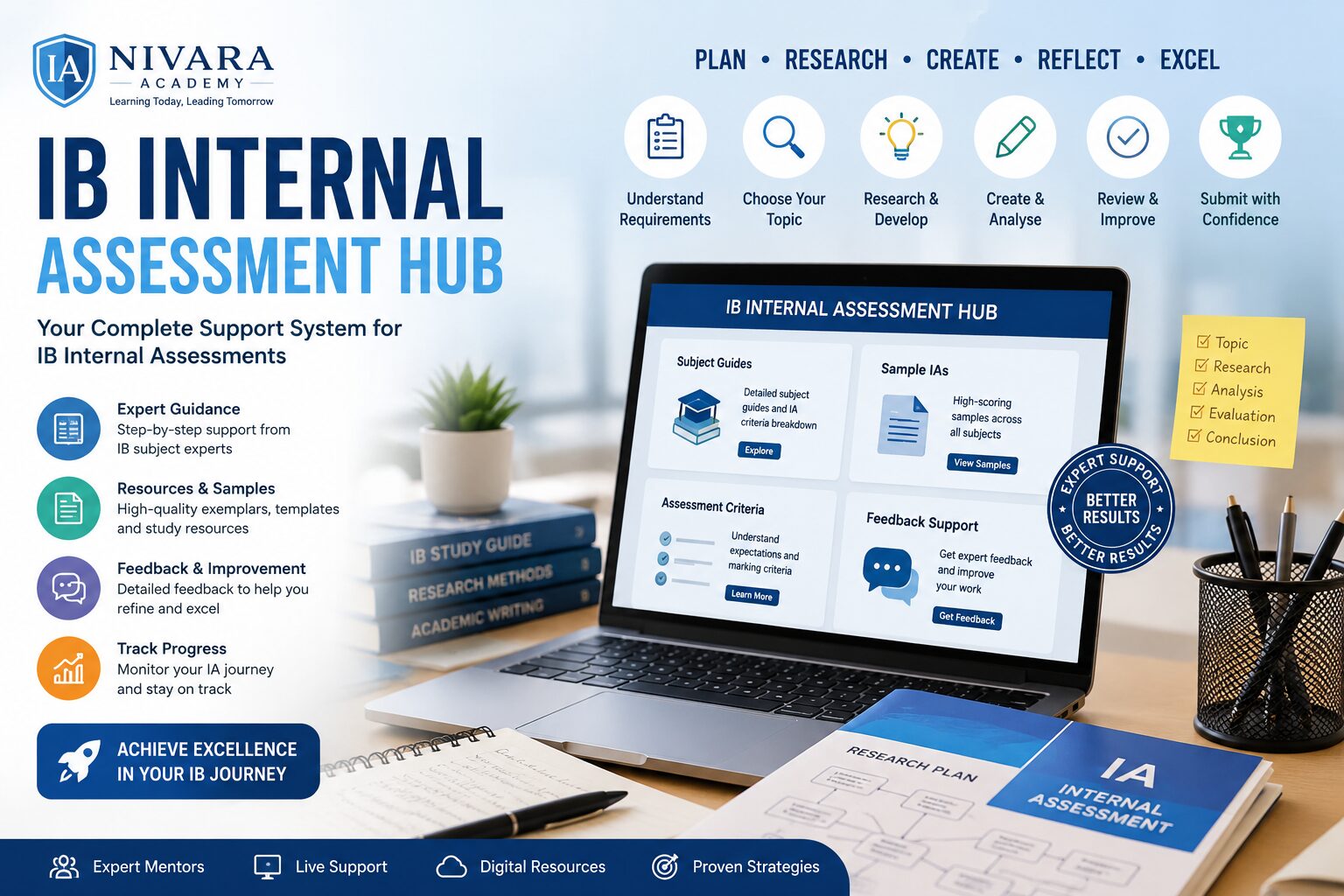
Table of Contents
- What is an IB Internal Assessment?
- Importance of Internal Assessments
- IB Internal Assessment Weightage
- IA Structure and Format
- How to Select an IA Topic
- Subject Specific IA Guidance
- Common IA Mistakes
- IB IA Timeline
- Frequently Asked Questions
What is an IB Internal Assessment?
The IB Internal Assessment Hub serves as a complete academic resource for students enrolled in the International Baccalaureate Diploma Programme. Internal Assessments are among the most significant components of the IB curriculum because they contribute directly toward final scores.An Internal Assessment is a teacher-supervised task designed to assess the skills, understanding, and application of concepts learned during the course. Unlike external examinations, Internal Assessments focus heavily on independent research, critical thinking, investigation, and analytical ability.The IB Internal Assessment Hub becomes essential because students frequently struggle with selecting strong topics, understanding rubrics, maintaining structure, and meeting deadlines.
Internal Assessments differ across subjects. In Physics, students perform experiments and scientific investigations. In Mathematics, students create mathematical explorations. In Chemistry and Biology, students conduct practical investigations, while language subjects may require oral assessments and analytical work.
IB Internal Assessment Subjects and Guidance
The IB Internal Assessment Hub provides subject-specific guidance because every subject follows different requirements and grading criteria. Understanding these differences can significantly improve your score and reduce common mistakes.
IB Physics Internal Assessment
Physics Internal Assessments involve experiments, variables, data collection, uncertainty calculations, and analytical evaluation. Students should select topics with measurable variables and sufficient investigation scope.
IB Chemistry Internal Assessment
Chemistry IAs require laboratory investigations and evaluation of chemical relationships. Strong topics usually contain quantitative analysis and experimental methodology.
IB Mathematics Internal Assessment
Mathematics IA focuses on mathematical exploration. Personal engagement and real-world applications can significantly strengthen scoring potential.
IB Biology Internal Assessment
Biology Internal Assessments often involve experimental investigations involving living systems, environmental variables, or biological processes.
IB Internal Assessment Weightage and Scoring
Internal Assessments contribute a substantial percentage toward final IB grades. The exact percentage varies depending on the subject. Understanding scoring rubrics helps students maximize performance in criteria such as exploration, analysis, communication, and evaluation.
IB Internal Assessment Progress Strategy
Recommended IB Internal Assessment Timeline
Month 1 — Topic Selection
Choose a focused and researchable IA topic aligned with subject requirements.
Month 2 — Background Research
Conduct literature review and collect reliable resources.
Month 3 — Data Collection
Perform experiments or gather required information.
Month 4 — Analysis
Interpret data and apply subject concepts effectively.
Month 5 — Evaluation and Drafting
Evaluate limitations and complete your first IA draft.
External Resources
The official International Baccalaureate website provides syllabus information, assessment frameworks, and academic updates.
Helpful supplementary material for strengthening mathematical and scientific concepts used during Internal Assessments.
How to Choose the Best Internal Assessment Topic
One of the biggest challenges students face during the Internal Assessment process is choosing the right topic. The IB Internal Assessment Hub exists because topic selection often determines the quality of the final investigation. Students frequently choose topics that are too broad, impossible to test, or lack sufficient academic depth.A strong Internal Assessment topic should be focused, measurable, researchable, and interesting to the student. Personal engagement is important because IB assessment criteria reward evidence of independent thinking and meaningful investigation.For example, a Physics Internal Assessment should include measurable variables and practical experimentation possibilities. A Mathematics Internal Assessment should focus on exploration and mathematical application. Chemistry and Biology topics should include controlled variables and quantitative analysis opportunities.Students should avoid selecting topics solely because they appear difficult or advanced. Complex topics do not automatically lead to higher marks. A clearly structured investigation with strong analysis often scores higher than an overly ambitious project.
Common Internal Assessment Mistakes Students Should Avoid
The IB Internal Assessment Hub also highlights frequent mistakes that reduce grades. Avoiding these mistakes can significantly improve final performance.
- Choosing an overly broad research question
- Weak data collection methods
- Insufficient analysis and interpretation
- Poor graph presentation
- Ignoring uncertainties and limitations
- Weak evaluation section
- Using unreliable sources
- Last-minute writing and editing
- Not following IB criteria properly
- Excessive descriptive content instead of analysis
Why the IB Internal Assessment Hub Matters
The IB Internal Assessment Hub helps students organize every stage of the Internal Assessment journey. Since Internal Assessments contribute directly toward overall scores, students benefit from structured guidance and planning.The purpose of this resource is not only to explain Internal Assessment requirements but also to provide practical support. Students often become overwhelmed due to deadlines, research challenges, and uncertainty about scoring criteria. Access to examples, timelines, subject-specific guidance, and structured resources can reduce confusion.The IB Internal Assessment Hub also encourages better time management and independent learning. By planning ahead and understanding expectations, students can focus on producing stronger investigations and analytical work.Successful Internal Assessments are built through planning, research quality, consistent revision, and critical thinking rather than last-minute effort.
Frequently Asked Questions
What is the IB Internal Assessment?
An Internal Assessment is a teacher-supervised assignment that evaluates practical skills, investigation ability, research quality, and analytical thinking within the International Baccalaureate curriculum.
How much do Internal Assessments contribute to final grades?
The contribution varies by subject. Most subjects include Internal Assessments as a percentage of the overall final score.
How many words should an IB Internal Assessment contain?
Word limits vary depending on the subject and assessment requirements.
Can I use online sources for Internal Assessments?
Yes, but students should use reliable academic and educational sources and provide proper citations.
Need Help With Your Internal Assessment?
At Nivara Academy, students receive guidance for Internal Assessments, subject selection, academic planning, and IB preparation strategies.
Book a Free Consultation