
IB Physics Topic-by-Topic Guide
Master every IB Physics topic including Mechanics, Waves, Electricity, Thermal Physics, Circular Motion and Quantum Physics with this complete IB Physics Topic-by-Topic Guide.
Start Learning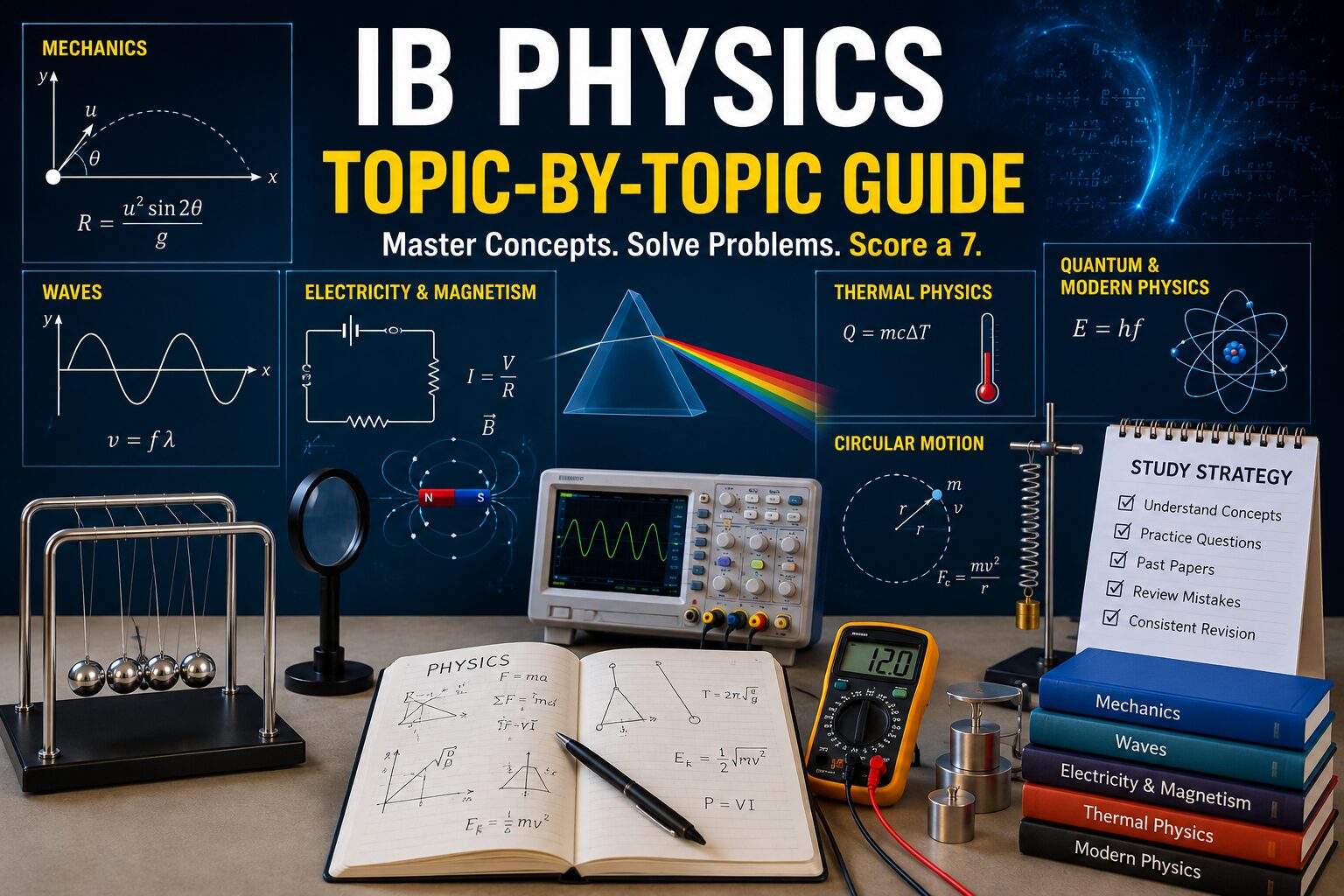
Explore Major IB Physics Topics
Mechanics
Learn motion, velocity, acceleration and forces.
Waves
Understand wave properties and oscillations.
Electricity
Study current, resistance and circuits.
Quantum Physics
Explore modern physics concepts.
Related Learning Resources
External Resources
Official IB OrganizationComplete IB Physics Topic-by-Topic Guide
The IB Physics Topic-by-Topic Guide helps students understand every concept systematically. Instead of memorizing formulas, students should focus on conceptual understanding and problem-solving approaches. IB Physics HL and SL require analytical thinking and consistent practice.
Mechanics
Mechanics is one of the most important sections in the IB Physics Topic-by-Topic Guide. Students learn displacement, velocity, acceleration, Newton's laws and motion graphs. Mechanics appears frequently in examinations and forms the foundation for later topics.
Thermal Physics
Thermal physics focuses on heat transfer, internal energy, specific heat capacity and kinetic theory. Students should understand particle behavior and temperature relationships.
Oscillations and Waves
Wave motion includes frequency, amplitude, wavelength and wave behavior. Understanding diagrams and calculations is essential for high scores.
Electricity and Magnetism
Students study circuits, resistance, current, magnetic fields and electromagnetic induction. Practice of circuit questions is extremely important.
Circular Motion
Circular motion explains centripetal acceleration and forces acting on rotating objects. Graph interpretation is important here.
Quantum and Nuclear Physics
Modern physics introduces radioactive decay, quantum concepts and nuclear reactions.
Motion Graph Visualization
How to Study Using This IB Physics Topic-by-Topic Guide
Students should avoid studying all topics together. The IB Physics Topic-by-Topic Guide works best when concepts are divided into manageable sections.
- Study one chapter daily
- Practice numerical questions
- Revise formulas weekly
- Use past papers
- Review mistakes regularly
- Create summary notes
Recommended Resources
IB Physics IA Ideas
Explore investigation ideas for high scoring Internal Assessments.
IB Math AA vs AI Explained
Compare IB Mathematics pathways.
IB Chemistry Study Guide
Improve chemistry concepts with detailed notes.
Frequently Asked Questions
Is IB Physics difficult?
IB Physics can be challenging because it focuses heavily on understanding concepts and applying them to unfamiliar situations. Consistent revision and problem solving improve performance.
Which topic is most important in IB Physics?
Mechanics, Electricity, Waves and Modern Physics frequently appear in examinations and form the basis for advanced concepts.
How can I score a 7 in IB Physics?
Focus on concept clarity, complete regular practice questions, solve past papers and review mistakes weekly.
Should I study HL and SL differently?
HL students should dedicate additional time for deeper understanding and complex problem solving.
Start Mastering IB Physics Today
Use this complete IB Physics Topic-by-Topic Guide to strengthen concepts, improve problem-solving skills and prepare effectively for HL and SL examinations.
Book Free Demo ClassConclusion
The IB Physics Topic-by-Topic Guide provides a structured approach for mastering the complete syllabus. Students should focus on building conceptual understanding rather than memorization. Topics such as Mechanics, Waves, Electricity and Quantum Physics require regular practice and revision.
For better performance, combine this guide with past paper practice and topic-wise revision schedules. Developing strong fundamentals will improve confidence and examination results.