
IB Physics Kinematics Explained
Kinematics is one of the most fundamental topics in IB Physics. According to the official IB Physics curriculum , students must understand displacement, velocity, acceleration and motion graphs to solve exam problems effectively.
What is Kinematics?
Kinematics is the branch of physics that describes how objects move. Instead of studying forces, kinematics focuses on measurable quantities such as displacement, velocity and acceleration.
Key Quantities in IB Physics Kinematics
Displacement
Displacement is the change in position of an object in a particular direction. Unlike distance, displacement is a vector quantity and includes direction.
Velocity
Velocity is the rate of change of displacement with time. It describes both speed and direction of motion.
Acceleration
Acceleration describes how quickly velocity changes with time. Positive acceleration increases velocity, while negative acceleration (deceleration) slows an object down.
Kinematics interactive explainer
Displacement is the straight-line change in position from start to finish — it has both magnitude and direction (it is a vector).
Velocity = rate of change of displacement. Speed is its magnitude; velocity also tells you direction.
Acceleration is the rate of change of velocity. Positive = speeding up; negative = slowing down (deceleration).
The four SUVAT equations let you solve any uniform-acceleration problem. Set any three known values and instantly see the rest.
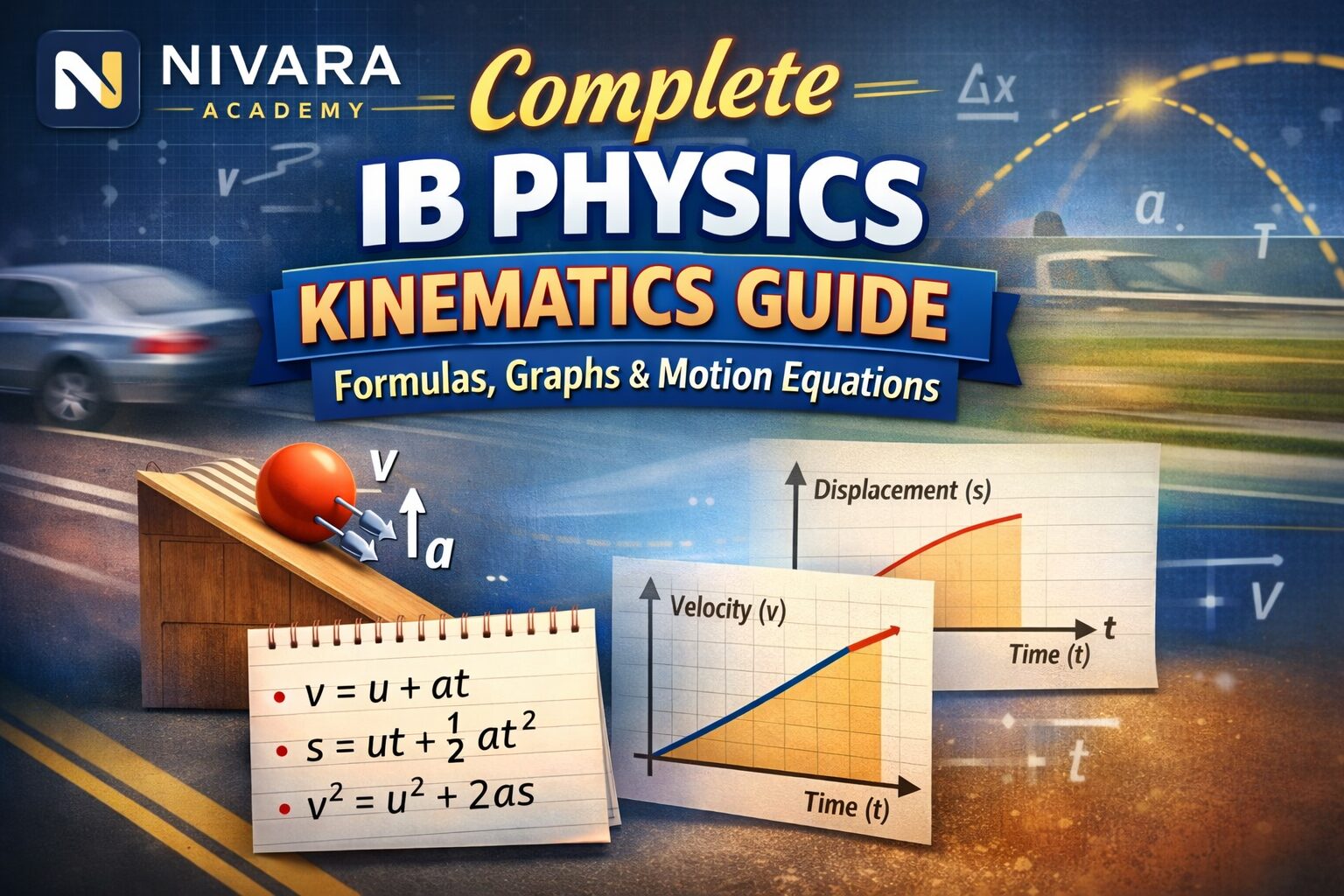
IB Physics Kinematics Equations
When acceleration is constant, the following SUVAT equations are used:
Velocity-Time Graph
In a velocity-time graph, slope represents acceleration and area under the graph represents displacement.
Interactive IB Exam Solver
A car accelerates from 0 m/s at 3 m/s² for 4 seconds. Find the final velocity.
Common Mistakes Students Make
- Confusing distance with displacement
- Using the wrong SUVAT equation
- Ignoring direction in velocity calculations
- Misinterpreting velocity-time graphs